Chronicle of Folly Foretold: How the “Star Wars” Prequels Anticipated Our Preposterous Present Political Moment

America, 2020

“Wait a minute, how did this happen? We’re smarter than this.”

“You have to do yourself a favor when you are out in the countryside and you see a chicken. Try to look a chicken in the eye with great intensity, and the intensity of stupidity that is looking back at you is just amazing.”

Almost entirely in spite of themselves, the Star Wars prequels have become the defining cultural artifact of our great national derangement. As much as anything else, they’re a prescient – if unintentional – portrait of just how stupid the slide into outright autocracy can be. Indeed, life has imitated art these past few months with President Trump’s intensely moronic and increasingly desperate attempts to nullify the results of the November 3 presidential election. For all their myriad flaws, the prequels exhibit remarkable verisimilitude in one important way: the fundamental absurdity and frequent idiocy that often lubricate the demise of democracy.

Though George Lucas clearly envisioned the prequels as an epic tragedy, he utterly failed to realize this ambition. But the accidental farce that resulted eerily mirrors our own experience over the past four years. When the Washington Post adopted the motto “democracy dies in darkness” after the 2016 election, for instance, Padme Amidala’s bathetic line that liberty dies “with thunderous applause” went from premium meme material to subversive punchline. No matter how grave our situation may actually be, it’s hard to take a newspaper’s pretentious slogan too seriously when it unconsciously echoes a pseudo-profound monologue on the collapse of freedom from Revenge of the Sith.

Indeed, the unintentional absurdity at the heart of the prequels can help us better appreciate the unremitting parade of folly we see in our own politics and society today. In that respect, at least, the plot and characters of the prequels are far more realistic than generally understood. Democracy doesn’t die in darkness, nor liberty amidst thunderous applause: they expire amidst a suffocating miasma of stupidity. We’ve mocked and laughed at the prequels for their glaring dramatic shortcomings, failing all the while to realize that we’re no better inoculated against the sort of idiocy on display. When we jeer at the Star Wars prequels, we ridicule ourselves.

The purpose here isn’t to rehash often-legitimate criticisms of the prequels, or point out their occasional silver linings. Rather, it’s to call attention to how the absurdity of the trilogy’s core narrative uncannily illuminates our own political predicament. That starts from the opening crawl of The Phantom Menace, when sweeping space opera and epic struggle between good and evil begins… with a trade dispute? From the very start, the ultimate dramatic tragedy of the prequels is readily apparent. What could have been a compelling tale involving the moral decay of the Jedi Order becomes an absurd if all-too-prescient farce on the decline of democracy. 

Enamored with his own narrative and with no one willing to tell him otherwise, George Lucas literally loses the plot of his own films and misses their thematic potential. He aims to present the fall of the Galactic Republic as the inevitable result of brilliant, byzantine machinations orchestrated by a devious evil mastermind: Chancellor-cum-Emperor Sheev Palpatine, also known as the dark lord of the Sith Darth Sidious. But the narrative we see in the films themselves shows that an ineffectual, morally decrepit Jedi Order bears as much – if not more – of the blame for the Republic’s collapse. 

Even after they learn that the Sith have returned to menace the galaxy at the close of The Phantom Menace, for example, the well-meaning but ineffectual Jedi Order displays a remarkable lack of urgency and curiosity toward this mortal threat. A decade passes between the events of that movie and its sequel, Attack of the Clones, and the Jedi appear to have done next to nothing to investigate the reappearance of their ancient enemy. Individual Jedi may be intelligent and honorable, but the Jedi Order we see in the prequels suffers from terminal institutional stupidity. Democracy dies in the Star Wars universe less because the villain’s an evil genius and more because the Republic and those sworn to defend it remain oblivious and complacent to the last.

There’s nothing necessarily wrong with the general narrative arc or many specific plot points of the prequel trilogy, however. Lucas simply executes them so poorly that they lose all dramatic weight, leading the prequels to blunder regularly into inadvertent farce. It’s not just Natalie Portman’s risibly mawkish delivery of what’s meant to be a chilling observation about the willingness of the masses to give up their freedom. The fact that it’s the buffoonish and half-witted Jar-Jar Binks who sets the Republic on a course for tyranny by moving to grant Palpatine emergency powers in Attack of the Clones pretty much sums up the essential folly at the heart of the Star Wars prequels. That’s an absurdity not too far removed from the bizarre reality of American politics and society in the waning weeks and months of 2020.

Indeed, President Trump’s ongoing and increasingly surreal attempts to nullify his decisive electoral defeat all seem far too stupid to actually succeed. Amidst far more pressing priorities like the COVID-19 pandemic and its resulting economic carnage, most of us seem instinctively incredulous that so obviously idiotic and outlandish an effort could even take place – much less succeed given the infinitesimal odds against it. This disbelief leads to outright denial or minimization of the threat to democracy and danger to America’s social fabric posed by Trump’s bid to throw out the results of the 2020 presidential election. We resemble the complacent and institutionally inept Jedi Order of the prequel trilogy more than many of us would like to admit, placing inordinate and unjustified faith in a broken system of politics and governance that will somehow save us from impending catastrophe.

Since the November 3 election, we’ve been treated to a cavalcade of stupidity unparalleled even in the Trump era. This descent into full-scale national absurdity began with a bizarre press conference at Four Seasons Total Landscaping in Philadelphia, and the pace has only accelerated since. Rudy Giuliani, former New York mayor turned Trump personal lawyer, almost literally melted down as he unspooled conspiracy theories during another unhinged press conference a week and a half later. The Trump campaign’s own lawyers have admitted in court that they have zero evidence for charges of voter fraud, losing almost sixty cases challenging the results – often laughed out of the courts by Trump’s own judicial appointees in the process. In one exceptionally ludicrous episode, the Trump campaign’s star witness in Michigan appeared inebriated as she gave formal testimony in support of the campaign’s crackpot claims.

It’s only grown even more ridiculous from there. Though roundly rejected by the Supreme Court, the Texas attorney general’s move to throw out the votes of four other states garnered the backing of seventeen other state attorneys general and 126 Republican members of Congress. Senator Ted Cruz, Republican from Texas, even offered to plead Trump’s preposterous case before the Supreme Court. Following the abject failure of this effort and the Electoral College’s formal acknowledgement of former Vice President Joe Biden as the nation’s next president, Trump convened a conclave of dunces consisting of “a pardoned felon, adherents of the QAnon conspiracy theory, a White House trade adviser and a Russian agent’s former lover” to ponder how he might remain president in spite of everything – including the possible use of the U.S. military to cling to power.

Sen. Ted Cruz (R-TX)

The utter absurdity and almost certain futility of these maneuvers should not blind us to the dangers involved or lull us into a false sense of security about the robustness of our political system. We’ve seen one of our two major national political parties shed any vestigial commitment to democracy at its most basic in order to indulge the childish fantasies of an authoritarian con-man. These tendencies date back to the early 1990s if not earlier, and they’ve slowly crept forward over time. As the Republican Party has become more ideologically conservative, it’s come to see any political opposition as by definition illegitimate. 

It’s no exaggeration, moreover, to say that Senate Majority Leader Mitch McConnell has earned the sobriquet “gravedigger of democracy” in the United States. In pursuit of his own ends, he’s enabled Trump just about every step of the way. Thanks in large part to his seeming tactical genius for obstruction, American domestic politics has become increasingly driven by the dictates of pure power politics. As a result, political leaders and movements on the right and, increasingly, the left will do whatever they think they can get away with if they believe it will serve some tactical objective. That’s a recipe for disaster, given that power politics are antithetical to the spirit of give-and-take necessary for democracy to function at even a minimal level.

But it’s not the inherent absurdity of Trump’s attempt to remain in power or the stolid robustness of America’s political institutions that will arrest our slide into further folly – it’s the seven million-plus national vote margin of Biden’s victory. The election simply wasn’t close enough to let stupidity prevail. Had the election come down to razor-thin margins in one or two states, it’s not hard to imagine that the Trump campaign’s farcical legal efforts might have paid off and secured him a second term. Even as it is, America will not be out of the woods until President-elect Biden takes the oath of office at noon on January 20. 

Or even after that. Four years of President Trump – and especially the bizarre two-and-a-half month interregnum between his election defeat and his successor’s inauguration – have left the political and social norms that make democracy work bruised, battered, and broken. Nor do our laws – against, say, blatant corruption and self-dealing – enforce themselves in the absence of these unwritten rules of acceptable political conduct. Shorn of these norms, politics simply becomes an all-out contest for power – a vulgar brawl that does little to address the real problems facing the nation and its citizens. So there’s absolutely no reason for complacency or self-congratulation about the strength of our institutions.

No matter how stupid, a failed campaign to smother democracy causes damage. The level of institutional support the Republican Party granted to Trump’s absurd attempt to nullify and overturn his election loss speaks for itself, regardless of what Republican office-holders say off the record or behind closed doors. Again, it’s not hard to imagine such a preposterous effort succeeding had the margin of Trump’s defeat been thinner than it actually was. If anything, the events of the last few months show that the Star Wars prequels underestimated the political and organizational stupidity involved in the erosion and eventual collapse of democracy.

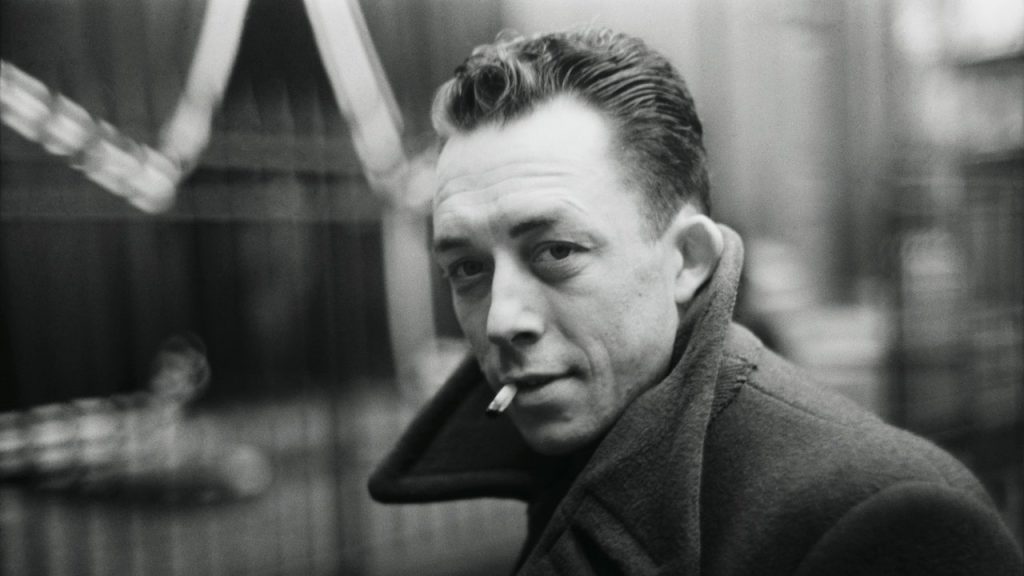
But if there’s any one lesson to be gleaned from the last several months, it’s that we should never underestimate the power of the idiotic or the absurd. That’s something the French existentialist philosopher Albert Camus noted in his novel The Plague:

When a war breaks out, people say: It’s too stupid; it can’t last long. But though a war may well be ‘too stupid,’ that doesn’t prevent its lasting.  Stupidity has a knack of getting its way; as we should see if we were not always so much wrapped up in ourselves.

We’d do well to remember that admonition ourselves. The failure to appreciate the stupidity involved in our current political moment can only accelerate our own collective death spiral. 

I like to think Camus would appreciate the surrealism involved here.

For all they do wrong and the ambitions they fail to achieve, the Star Wars prequels do inadvertently grasp this fundamental truth of human existence – and propagate it widely. Without even trying, they plumb the depths of folly in ways that only our own present political circumstances can rival. Even after the past four years of the Trump administration, the intensity of stupidity involved in President Trump’s attempt to cling to power after losing an election remains quite shocking. Indeed, it far exceeds the prequels – and indeed Camus, the great philosopher of absurdity himself – in its idiocy.

We’ll need to remain vigilant against the absurd for the foreseeable future. The madness may abate when Trump leaves office, but the miasma of stupidity left behind in his wake will persist. 

Thoughts on Pain, Suffering, and Loss in the “Star Wars” Mythos

Ahsoka, Mando, and Baby Yoda enjoy a moment. (Credit: Lucasfilm)

If you’d told me at the beginning of the year that I’d wind up writing not one, not two, but three pieces on Star Wars, I’d have told you that you’re nuts. But here I am, drawn back to a galaxy far, far away and a long time ago by the first live-action appearance of one of my favorite characters, Ahsoka Tano, in a recent episode of The Mandalorian – and, of all things, a Twitter conversation. It was claimed online that the Star Wars saga failed to adequately address fundamental questions of pain, loss, and suffering that occur in its allegedly absurd fictional universe. 

That’s true enough as far as the nine main Star Wars films go. Neither the preposterous prequels, the classic original trilogy, nor the offensively dull sequels ever really contend with the loss, suffering, and mass death that seems to permeate and define in the overallmythos. Though it goes largely unnoticed and unremarked upon, our Star Wars heroes inhabit a fictional universe that’s extraordinarily dark and despairing.The examples are legion: the extermination of the Jedi and the fall of the Republic, the destruction of Alderaan and the general barbarity of the Empire, and rampant criminality bordering on anarchy across the galaxy

It’s no exaggeration to say that we’ve seen the inhabitants Star Wars fictional universe experience one massive trauma after another. But there hasn’t ever been any attempt in the core narrative to engage with any of the myriad atrocities portrayed on screen in any real way. If anything, we’ve seen the movies brush away mass murder as a waypoint on the road to redemption for villains like Darth Vader and Kylo Ren. 

Other, similar fictional universes have done a much better job dealing with loss, pain, and suffering at both the individual and narrative levels. The emotional fallout of Spock’s death in Star Trek II: The Wrath of Khan, for instance,reverberated across the subsequent two movies for Captain James T. Kirk and the crew of the starship Enterprise. In the Marvel Cinematic Universe, we see Tony Stark grapple with the personal repercussions of his own actions and those of the Avengers across a number of films over the span of a decade. Likewise, loss and suffering stand out as central thematic and emotional concerns for the characters and narrative of Avengers: Endgame

All the same, it’s wrong to say that Star Wars hasn’t confronted basic human concerns of pain and loss – it has, just not on the big screen. Not in the vapid koans offered by Yoda and the like about fear, anger, and suffering, but in characters like Ahsoka, the Mandalorian, and Grogu (the character formerly known as the Child and Baby Yoda) that populate television series like The Clone Wars and The Mandalorian. The further we travel from the narrative arc of the three main film trilogies, the more compelling Star Wars becomes and the more we’re able to dig into its themes. These series and characters manage to subvert the shallow, perfunctory morality established in the main series without succumbing to an equally banal shades-of-grey moral ambiguity in the process.

That’s fairly clear when it comes to the title character of The Mandalorian. We learn in the show’s first season that Mando himself was orphaned during the Clone Wars and taken in by a fanatical Mandalorian sect, a backstory that doubtless exerted a critical influence on his own decision to save the Child from the clutches of the erstwhile Empire. Likewise with the Child himself, who survived the fall of the Jedi Order and was hidden for his own protection. Ahsoka tells us that his memory then becomes dark, with Grogu seeming “lost” and “alone.” As the series progresses, we’re almost certain to hear more of the Child’s history and watch Mando continue to evolve as a character.

But it’s through Ahsoka more than any other character that we see and experience the pain, loss, and suffering inherent in the fictional Star Wars universe – and the necessity of staying true to ourselves in spite of it all. She’s certainly endured more than her fair share of profound hardship: a personal loss of faith in the Jedi Order after it callously abandoned her, betrayal by her clone comrades-in-arms during the Jedi purge at the end of the Clone Wars, and the fall of her former master and friend Anakin Skywalker to the dark side of the Force. 

As a result, it’s not hard to detect a subtle yet deep undercurrent of sadness the older Ahsoka we encounter in The Mandalorian. That’s apparentwhenever she references the past, whether warning that she’s seen what fear and anger “can do to a fully trained Jedi Knight – to the best of us,” informing Mando that “the Jedi Order fell a long time ago” (and in more ways than one, as she well knows), or sadly noting that “there aren’t many Jedi left.” Rosario Dawson’s fine performance conveys a wisdom earned through harsh personal experience. But what’s more noticeable and noteworthy is just how often Ahsoka smiles after everything she’s experienced – and even under less-than-ideal present circumstances.

From her very first appearance in the Star Wars mythos, Ahsoka has stood out out for her basic humanity and fundamental sense of decency. She welds an ironclad sense of resolve and determination to an intrinsic compassion and concern for others. Ahsoka consistently adheres to a set of core moral and ethical commitments throughout her story, demonstrating a constancy of purpose that governs her actions and behavior. When we meet up with her again in The Mandalorian, she’s neither world-weary and pessimistic nor blithely optimistic about the state of the galaxy or human nature. In an ethos at odds with the superficial moralism and high politics of the nine main Star Wars films, she does what she can where and when she can. In the end, Ahsoka knows that she doesn’t need to alter the course of galactic history to do good and make a positive difference – even if that just amounts to liberating a small town on a backwater planet from the cruel despotism of petty tyrant.

That’s apparent from the the moment she encounters Mando and the Child. After a brief skirmish that ends with Mando telling her they need to talk, Ahsoka looks at Baby Yoda and says, “I hope it’s about him.” She and the Child bond quickly, with Ahsoka smiling as she and Grogu silently sense each other’s thoughts. Tugging on a thread running back to the final episodes of The Clone Wars, Mando insists she train the Child since “He needs your help.” But it’s out of concern for the Child himself that Ahsoka refuses to train him as a Jedi, vowing that she will not start him down her one-time master’s dark path – and why she provides an alternative that allows Grogu to stay with Mando at the end of the episode. 

Ahsoka’s humanity also comes through in her attitude toward attachments. We’re told across movies and television series that attachments are forbidden to Jedi: as an oblivious Yoda unhelpfully explains to Anakin Skywalker in Revenge of the Sith, “The fear of loss is a path to the dark side.” While Ahsoka doesn’t reject this line of reasoning outright, she’s clearly a person who cares deeply about others and values her friends. In the final episode of The Clone Wars, after all, she took pains to bury the clone troopers who had just been trying to kill her. She refuses to train Grogu, moreover, not simply because he’s formed a strong attachment to Mando but because of the fearful nature of that attachment. 

Indeed, Ahsoka displays an attitude toward attachments and relationships that’s almost Stoic in nature – one that recognizes that the impermanence of our lives and the ultimate transience of our connections with others are what make them truly valuable. In marked contrast with the unfeeling and uncaring detachment promoted by the Jedi Order, Ahsoka understands that non-attachment and compassion are not just compatible in theory but mutually reinforcing in fact. Her commitment to her moral and philosophical ideals allows her to remain true to herself in otherwise grim circumstances.

In the end, Ahsoka’s story reminds us that pain, suffering, and loss don’t need to break us, much less define us as individuals. Despite her own personal history of loss and suffering, Ahsoka maintains her basic humanity and decency in the face of a brutal and indifferent universe. As she makes her way through the galaxy, Ahsoka makes clear that it’s how we handle hardships and setbacks that matters in life – and whether we remain true to our own moral and ethical commitments – not simply whether or not they occur. 

Whatever the faults of the rest of the Star Wars fictional universe, its television incarnations give us much raw material to work with and chew over. Indeed, The Clone Wars and The Mandalorian amount to an implicit critique of the shallow moral narratives of the nine main films – but without dishonoring or disrespecting them. They build on, deepen, and further explore the Star Wars mythos in intriguing and fascinating new ways while giving us memorable new characters like Mando, Grogu, and Ahsoka.

If Star Wars is to have a future, this is the way. 

“Lives of the Stoics”: A Worthy Addition to the Modern Stoic Canon

Review: Lives of the Stoics: The Art of Living from Zeno to Marcus Aurelius by Ryan Holiday and Stephen Hanselman

By a strangely fortuitous set of circumstances, I happened to read Lives of the Stoics: The Art of Living From Zeno to Marcus Aurelius by Ryan Holiday and Stephen Hanselman amidst a comically inept but no less dangerous attempt by an American president to nullify his electoral defeat and remain in power in defiance of American law and tradition. In this particular moment, it’s hard not to read the book as anything less than an implicit broadside against President Donald Trump and his enablers. Though Holiday and Hanselman themselves refrain from such a direct case, the parallels between the early twenty-first century America and the ancient Greco-Roman world of the ancient Stoics are simply too uncanny to ignore. 

But Lives of the Stoics has much more offer than yet another extended historical analogy to contemporary American politics and society that will likely fade in the years to come. Above all else, it’s an eminently readable call to the philosophical life – or at least a life that’s imbued with a more philosophical outlook. Though it lacks the intellectual weight of other modern Stoic texts by the likes of Donald Robertson, Massimo Pigliucci, or William Irvine – to say nothing of the academic works by scholars like Margaret Graver or Gretchen Reydams-SchilsLives of the Stoics remains an engaging and lively guided tour through the origins, evolution, and practice of Stoic philosophy in the ancient world.

While no one will confuse Lives of the Stoics with an academic tome, the book does make a real contribution to the burgeoning canon of modern Stoicism. More intellectually in-depth contemporary treatments of Stoic philosophy tend to focus on those later Roman Stoics like Seneca, Epictetus, and Marcus Aurelius whose written works have survived the millennia more or less intact. These books also usually trace the school’s genealogy back to its founder, Zeno of Citium (or Kition), and his two successors as head of the Stoa, Cleanthes and Chrysippus of Soli. As Holiday and Hanselman note, much of the work of this founding generation has unfortunately been lost to posterity – including, for instance, the more than 705 volumes known to have been written by Chrysippus during his pivotal tenure as head of the school.

Often left out of these narratives are lesser-known but no less important figures in the development of Stoic philosophy like Diogenes of Babylon, the fifth head of the Stoa, and Panaetius, the school’s leader toward the end of second century BCE. It’s here where the book’s value lies: by shining a spotlight on these obscure yet influential Stoics, Holiday and Hanselman allow us to see Stoic philosophy evolve and grow in something resembling real time. We watch as new heads of the Stoa like Diogenes and his immediate successors, Antipater of Tarsus and Panaetius, put forward new ideas to fill in gaps or extend the philosophy’s scope, reach, and intellectual power.

Lives of the Stoics reminds us that Stoicism did not emerge fully formed from the mind of Zeno after he found himself shipwrecked in Athens. It accreted and accumulated new ideas and concepts over time, providing a beautiful illustration of the school’s own focus on humanity’s capacity for both reason and moral progress. Through their set of biographical narratives, Holiday and Hanselman demonstrate that Stoicism was and remains a living philosophy, valuing wisdom above all while maintaining a strong allergy to dogma. Or as Seneca put it in a letter to his friend Lucilius (33.11), “Those who advanced these doctrines before us are not our masters but our guides. The truth lies open to all; it has not yet been taken over. Much is left also for those yet to come.” 

As much as anything else, Stoicism recommends active participation in public life as the best way to serve and advance the common good. It’s a theme that emerged early on in the history of the philosophy, with its founding triumvirate writing now-lost abstract and theoretical works on politics in an ideal society. “These debates,” Holiday and Hanselman observe, “were little more than arguments of different types of utopia.” The turn to practical politics and public engagement came when Diogenes of Babylon traveled with a gaggle of fellow philosophers to Rome in order to plead with the newly ascendent Mediterranean hegemon for leniency toward their own home city of Athens.


By all accounts, Diogenes charmed Rome’s elites and helped win a reduced fine for Athens. In so doing, he marked himself out as the first Stoic philosopher to contend directly with the problems of practical politics – but he would be far from the last. As the biographical narratives in Lives of the Stoics progress, we see various Roman Stoics struggle to meet their philosophical obligation to engage in public life and maintain their principles amidst the morally treacherous and often fatal politics of the late Roman Republic and the subsequent Empire. Before serving as head of the Stoa, for instance, Panaetius actively engaged in Roman politics and policy through his personal involvement in the political and intellectual circle centered on the general Scipio Aemilianus.

But as Holiday and Hanselman show, subsequent Stoics would find this commitment to an active public life one of their most trying philosophical obligations.  There’s no clear exemplar of how one should square philosophical ideals and principles with practical political engagement to be found in Lives of the Stoics (save Marcus Aurelius),though there are many potential role models and guides to choose from. Like Seneca millennia ago, Holiday and Hanselman hold up Marcus Porcius Cato – staunch defender of the republic and nemesis of Julius Caesar – as perhaps the best example to follow. 

While Seneca held up an idealized Cato as a moral role model in his letters to his friend Lucilius, Holiday and Hanselman have to contend more directly with Cato’s rather mixed historical record. Modern accounts of the fall of the Republic by Anthony Everett and Edward Watts, for instance, make it clear that Cato’s own inflexibility helped bring about the demise of his cherished Republic. As Holiday and Hanselman themselves acknowledge, “Cato’s inflexibility did not always serve well the public good.” We may admire Cato for his willingness to stand by his principles up to the end, but it seems equally clear that his moralistic obstinacy and rigidity was as much a vice as a virtue.

For his part, Seneca typically comes in for harsh criticism due to his association with the deranged emperor Nero. Perhaps that’s because Seneca left behind so much written material with which to judge the apparent contradictions between his philosophical commitments and his well-compensated political work for one of Rome’s most notorious tyrants. But I personally find it hard to be so unsympathetic toward Seneca and his predicament, in particular his failure to bring out the best in Nero. In his own philosophical writings – especially the letters on ethics to Lucilius written late in his life – Seneca comes across as a deeply flawed human being struggling to live up to his principles under trying circumstances. Unlike Cato, he does give the impression of a man parading his own moral righteousness around for all to see.

Lesser-known individuals profiled in Lives of the Stoics may perhaps provide more salutary examples of engagement in public life while maintaining one’s principles. One in particular stands out: Publius Rutilius Rufus, a political figure from the generation that preceded the fall of the Republic. Rutilius stood out for his “fierce but quiet honesty” and opposition to the corruption of the late Republic, and later found himself exiled to Smyrna on false charges of corruption ginned up by his political enemies. He refused to return from exile when offered the opportunity, saying he would rather Rome be embarrassed by his banishment than suffer the likely civil war that would allow him and other exiles to come home. It’s a compelling counterexample to Cato’s destructive self-righteousness.

Still, it’s difficult to read Lives of the Stoics at this particular moment in time as anything other than a damning indictment of President Trump and his enablers. Lines that might otherwise seem rather apolitical or unexceptional assessments of ancient Roman politics and society take on a sharper edge and cut close to the bone of contemporary American politics and society. After describing an encounter Panaetius had with the corpulent King Ptolemy VIII of Egypt, for instance, Holiday and Hanseman go on to observe that “Fat and lazy heads of state are another recurring character of history.” 

The Roman politician and general Marius comes in for particular scorn: the authors note that all that matters to populist politicians like him “is their iron grip on their ignorant base and the power that comes from it.”  Following their account of the philosopher and gifted polymath Posidonius’s encounter with Marius on his deathbed, Holiday and Hanselman pause to raise “a timeless question: If you actually knew what ‘success’ and ‘power’ looked like – what it did to the people who got it – would you still want it?” Posidonius, they continue, went on to write down his “firsthand observations about the costs of ambition and insatiable appetites” he’d seen in would-be dictators and tyrants from Sicily to Athens. When Marcus Aurelius repeatedly references the common good in his Meditations nearly two centuries later, moreover, Holiday and Hanselman view it as noteworthy “considering how nearly all of his predecessors [as emperor] viewed the purpose of the state.”

Beyond these explicit observations on the corruptions of power and ambition, Lives of the Stoics serves as a powerful but largely implicit rebuke to contemporary American politics and society. As related by Holiday and Hanselman, the virtues and character traits advocated, pursued, and sometimes embodied by the ancient Stoics stand diametrically opposed to those displayed by President Trump and his hangers-on. Just as the lives of the ancient Stoics themselves stood in stark contrast to the likes of Caligula and Nero, the biographical narratives presented in Lives of the Stoics stand in stark contrast to President Trump’s willful and ongoing detachment from the reality of his electoral defeat.

Lives of the Stoics may read as a strong reproach Trump and his enablers, but it levels this charge in ways that ensure that the book itself will will endure beyond the current presidency. Holiday and Hanselman content themselves with creating a deep but implicit contrast between the philosophy they champion and America’s current political leadership. They do not need to make direct attacks or accusations against Trump and his fellow-travelers; those of us living through the present moment of executive derangement will find their indictment clear enough.

But Trump represents only the most deranged and extreme incarnation of the negative traits and impulses all too prevalent in our national politics and shared social life. Too often, many of us working in politics and policy lose sight of the common good, our philosophical commitments, and our personal relationships – in a word, the things that make life worth living – as we indulge our conjoined desires for power and notoriety. Making matters more absurd, we frequently define power and notoriety in preposterously narrow ways: the next rung on the professional ladder, an appointment to a particular position, or a favorable mention from a former administration official on social media. Even mere proximity to power often proves seductive enough. These pathologies coursed through our political and social lives well before the advent of the Trump presidential campaign, and they will persist when he leaves office in January 2021. 

In that way, Lives of the Stoics points toward universal aspects of the human condition and the timeless truths of philosophy. It’s an exceptionally welcome call to remain true to ourselves and our most basic principles as we participate in public life.  As it is, we’re too easily led astray by the temptations of greed, power, or moral vanity and self-righteousness. Unlike Cato, we need to recognize when and where we might be deceiving ourselves. Ideology and ambition don’t override our most fundamental moral obligations and philosophical duties to ourselves and others, much less our shared humanity. In the end, we ought to remember why we’re involved in public life in the first place and attempt to navigate its rocks and shoals as best we can.

All in all, Lives of the Stoics proves itself a worthy addition to the modern Stoic canon. As with Holiday’s other books, Lives of the Stoics comes across as perhaps too breezy and casual in tone. A number of his modern analogues feel deeply incongruous, from a comparison of the founders of PayPal with the post-World War I “Lost Generation” and the Scipionic Circle of Panaetius to the use of lyrics from the Alice in Chains song “Nutshell” to help explain the attitude of the philosopher and statesman Agrippinus. These faults don’t undermine the book as a whole, but they do occasionally clash with the subject matter and unnecessarily jar the reader.

Still, Lives of the Stoics remains an excellent invitation to the philosophical life. We see how Stoic philosophy accretes and evolves over time – and how its adherents tried to put it into practice, however imperfectly. For that reason alone, the book makes a valuable contribution to the contemporary Stoic canon. As Holiday and Hanselman put it in their conclusion, “That’s what Stoicism is. It’s stretching. Training. To be better. To get better. To avoid one more mistake, to take one step closer to the ideal. Not perfection, but progress – that’s what each of these lives was about.”

Hopefully, Lives of the Stoics will whet the philosophical appetite of novice readers encountering Stoicism for perhaps the first time – and lead them to explore the modern Stoic canon more deeply, to say nothing of picking up some academic works on the philosophy and the writings of the ancient Stoics themselves. Even if Lives of the Stoics encourages its readers to take a slightly more reflective and philosophical perspective on their own lives, it will have made a difference.

Playing Ourselves: A Review of “Active Measures” by Thomas Rid

Review:

Active Measures: The Secret History of Disinformation and Political Warfare by Thomas Rid

Thomas Rid’s Active Measures: The Secret History of Disinformation and Political Warfare certainly lives up to its title, providing a brisk archival jaunt through the last hundred years of attempts by intelligence agencies to twist reality to their own ends. More importantly, however, it puts disinformation in proper perspective; though disruptive when done well, disinformation hasn’t proven all that successful in practice. In particular, the book presents Soviet and later Russian disinformation campaigns as largely inept or ineffective – and hardly the work of the omnipotent puppet masters that populate the American public imagination today.

But the picture Rid paints is far from rosy: key institutions and elites in open societies have proven to be all too willing – if not necessarily witting – accomplices of foreign intelligence agencies in their quest to disseminate disinformation and sow discord around the world. Indeed, the producers of disinformation rely on this mostly unintentional support from within the societies they aim to undermine: as one East German intelligence officer asked rhetorically in the late 1980s, “What would active measures be without the journalist?” It’s clear from Rid’s account that open societies ultimately wind up playing themselves far more than they’re played by foreign intelligence agencies. 

That leads to one of the book’s main weaknesses, namely its failure to examine disinformation campaigns that don’t originate with state intelligence agencies. In part that’s due to Rid’s otherwise admirable reliance on archival sources and, in the case of more recent Russian active measures, technical expertise. It’s not that Rid fails to acknowledge that activist groups and political parties can be involved in disinformation campaigns – indeed, he observes that Soviet and Russian intelligence agencies targeted “activists and intellectuals who criticized the U.S. government” as part of their own active measures campaigns – it’s rather that the book does not explore as fully as it could the possibility that these groups could carry out their own disinformation campaigns. 

Still, Active Measures ought to serve as a wake-up call to elites and institutions – and the news media in particular – in open societies to apply greater critical scrutiny to the agendas promoted by their sources. These elites and institutions have proven noticeably reluctant to engage in introspection about the pivotal role they’ve played in the disinformation campaigns carried out by hostile foreign intelligence services, preferring instead to blame a supposedly gullible public duped by “fake news” planted on social media platforms. But Rid rightly brings our focus back, at least in part, to remarkably credulous news media and activist cultures that serve as prime vectors for disinformation. 

Overall, Rid’s history of disinformation makes plain that active measures possess a highly inflated reputation. For all the hype they’ve received in recent years, the track record of disinformation campaigns shows only a handful of success stories. With some quite notable exceptions, moreover, it’s hard to understand how these successes actually altered the course history in meaningful ways. It’s not unreasonable to conclude from Rid’s narrative that disinformation campaigns haven’t really mattered all that much in the grand scheme of international politics.

Perhaps the most successful active measure pursued by the Soviet bloc during the Cold War involved East Germany’s Stasi. In the early 1970s, the West German government led by Social Democratic Chancellor Willy Brandt faced a vote of no-confidence in the Bundestag; East German authorities preferred Brandt’s dovish Ostpolitik policies toward the Soviet bloc over those of his potential replacements. Brandt’s government was saved by two abstentions from conservative deputies, one of whom confessed to having been bribed by the Stasi a little over a year after the vote. After the fall of the Berlin Wall, however, Germany’s federal prosecutors revealed that the other member of parliament abstained after receiving money from a journalist and Stasi asset posing as an agent of American influence. As Rid puts it, the deputy “took the money and voted for the Americans. Or so he thought.”

Throughout the Cold War, active measures carried out by the Soviet bloc created headaches for the United States and its allies in Europe. But it’s hard to say they had much of an effect on the ultimate outcome of the ideological conflict between Moscow and Washington. Nonetheless, active measures had considerable success in suborning journalists and activists to Soviet strategic ends. In the late 1960s, for instance, the KGB fabricated nuclear war plans for NATO and leaked them alongside a trove of legitimate documents provided by a disgruntled U.S. military courier earlier in the decade. Left-leaning publications in Italy, West Germany, and the UK ate up these salacious plans and did the KGB’s work for it. 

A similar dynamic recurred in the late 1970s when radical anti-intelligence community activists published and publicized an alleged U.S. Army counterinsurgency field manual supplement forged by the KGB. This counterfeit stoked far-left paranoia with its recommendation that Army intelligence officers should penetrate insurgent groups and encourage violent attacks. Here again, disinformation coursed through left-wing channels across Europe and allowed radical activists to absolve left-wing terrorists of responsibility for the kidnapping and murder of former Italian prime minister Aldo Moro. More important, Rid tells us, was the fact that anti-intelligence community activists “added real value to an existing active measure, and improved its performance.”

From the late 1970s to the end of the Cold War, Soviet bloc intelligence agencies actively penetrated Western anti-nuclear and peace movements in order to use them as diplomatic and political bludgeons against the United States and its NATO allies. The KGB and its satellite intelligence agencies claimed success in derailing U.S. development of a neutron bomb in the late 1970s, for instance – but it’s unclear what this tactical success achieved for the Soviet bloc in the long run. 

More ominous was the KGB-led campaign to use active measures in support of U.S. and Western European peace movements in the 1980s. They plowed fertile soil, with “hardened activists” indifferent to the sources or even veracity of leaks that confirmed their pre-existing ideological dogmas. Here again, the Stasi was most active: it recruited West German peace activists as collaborators and established a front organization of former NATO generals to champion the Warsaw Pact perspective on the nuclear arms race. Since most people want peace and fear war, one KGB defector explained, Soviet active measures aimed “to persuade the public that whatever America does endangers peace, and that whatever the Soviet Union proposes furthers peace.” “The trick,” Rid writes, “was to make activists and others support Soviet policy unwittingly, by convincing them that they were supporting something else.”

Perhaps the strangest twist to the Cold War-era symbiosis between Soviet bloc disinformation campaigns and activist groups can be seen in the emergence of HIV/AIDS conspiracy theories during the 1980s. As Rid relates, the KGB and Stasi glommed onto these conspiracy theories only after they’d started to circulate and fester on “the far-left fringes of American civil rights activism.” Though the Soviet bloc only pushed this particular suite of conspiracy theories for a short period of time, mainstream news media in the United States and Europe picked up a single Soviet-sponsored AIDS conspiracy theory and propagated it far more successfully than the KGB or Stasi could ever hope to do themselves. 

In the roughly two decades following end of the Cold War and the demise of the Soviet Union, active measures largely died down. They did not disappear entirely, but the scale and scope of such campaigns declined as Soviet bloc intelligence agencies like the Stasi disbanded and Russia coped with the collapse of communism. Though Russian intelligence services began exploiting the disinformation possibilities of the internet by the late 1990s – Rid notes that the first known “kompromat” effort dates to 1999 – it took another decade or so for these agencies to merge “old-school intelligence leaks involving compromising material” with “hacking and high-tech internet sabotage.”

By the 2010s, Russian intelligence began road-testing these new disinformation techniques in Ukraine. It started with the February 2014 leak of an intercepted conversation between senior State Department official Victoria Nuland and the U.S. ambassador to Ukraine to various social media platforms, a leak that was then amplified by American and European press coverage. Based on Rid’s account, the Nuland leak appears to be the first known use of digital active measures by a foreign intelligence agency. Other similar attempts would follow that year in Ukraine, including forged emails attributed to a U.S. Army attaché detailed to Ukraine and a hack of Ukraine’s Central Election Commission.

These digital active measures in Ukraine set the stage for Russia’s disinformation campaign against the United States ahead of the 2016 presidential election. As Rid persuasively argues, however, the effectiveness of Russia’s active measures has been grossly exaggerated over the years since the election. A look at the data, for instance, shows that the much-vaunted Internet Research Agency – Russia’s notorious troll farm – had at best a miniscule impact on the presidential campaign. Just 8.4 percent of overall IRA activity related to the election, while the IRA itself “generated less than 0.05 percent of all election-related posts.” Indeed, the IRA viewed its primary audience not as easily-deceived American voters but the government-linked Russian oligarchs who paid their salaries. Only after the fact did the mainstream press and Congressional investigators elevate the IRA’s rather feeble disinformation efforts into a world-historical active measures campaign.

More consequential were GRU – Russian military intelligence – hacks of the Democratic National Committee and Hillary Clinton campaign chair John Podesta. But even here, Russian digital active measures proved far less proficient and capable than many Americans have been led to imagine. Though technically adept and just plain lucky in its penetration of U.S. computer networks, the GRU had little sense of what to do with the data it pilfered from DNC servers and Podesta’s personal email account. Indeed, “GRU officers were unable to recognize and extract politically juicy content from Podesta’s [email] inbox” despite having had access to the account for over two months before they started to publicly disseminate its contents.

When its initial attempt to push its active measures flopped, the GRU appealed to WikiLeaks founder Julian Assange for help. At the same time, the GRU set up a poorly-disguised online cut-out known as “Guccifer 2.0” to leak the stolen Democratic campaign files. Assange prodded the GRU to send more files his way, telling its sock-puppet Twitter account that WikiLeaks “will have a much higher impact” than a thinly-veiled Russian intelligence pop-up site. What’s more, GRU officers did not appear to have much of a grasp of the internal Democratic Party politics in which they hoped to interfere. By mid-July 2016, the GRU sent WikiLeaks a cache of hacked DNC files for Assange to publish.

American political journalists then did their part, “rummaging through the dump in search of scandal.” Reporters from mainstream news outlets like Politico and Der Spiegel “regularly corresponded” with GRU officers on Twitter, while a number of influential journalists “remained usefully ignorant, either wittingly or unwittingly.” That October, WikiLeaks released the contents of Podesta’s inbox – just an hour after the U.S. intelligence community publicly identified Russia as the culprit behind the DNC hack. Though these leaks fueled a political media feeding frenzy that severely damaged the Clinton campaign at critical moments, they were not the result of an adroit and far-sighted Russian disinformation campaign. As Rid notes, the GRU proved so bad at media outreach that it unintentionally showed “how much value Julian Assange added to their campaign.” 

Throughout Active Measures, Rid remains largely focused on Russian state-sponsored disinformation campaigns. But it’s hard to read the book and not come away intensely critical of the indispensable roles played by activist groups and the news media in disseminating disinformation far and wide. That’s especially the case when it comes to contemporary disinformation campaigns, where nihilist activists like Julian Assange materialize at pivotal moments to guide and assist culturally incompetent Russian intelligence agencies.

Rid lays his cards on the table early on: “Activist internet culture shrouded what used to be a shadowy intelligence tactic in a new, star-spangled cloak of crypto-libertarianism.” Much later, he characterizes Edward Snowden as a “lowly NSA contractor, under the spell of transparency activism.” Nevertheless, naïve digital libertarians and a credulous press colluded to promote Snowden’s massive dump of classified information and, in many cases, themselves. Media outlets, Rid remarks, often “ran incomplete and error-ridden stories” that frequently overstated the collection and interception capabilities of American and British signals intelligence agencies. “Journalists and opinion leaders,” he writes, “were now more willing than ever to embrace anonymous leaks without spending too much time checking on their provenance or veracity.” 

In retrospect, it’s hard not to see the Snowden leaks and the hysteria that surrounded them as a de facto disinformation campaign in and of itself. The mass release of sensitive intelligence documents engineered by Snowden and his journalistic helpers amounted to what early Trump booster Steve Bannon would later call “flooding the zone with shit.” These leaks not only induced a widespread moral panic about “mass surveillance” that damaged U.S. national security, “they formed the perfect techno-cultural cover for active measures.” Rid makes a compelling if indirect case that stories about alleged NSA surveillance of German Chancellor Angela Merkel’s cell phone were in fact an active measure of unknown provenance that slipped into the news cycle amidst “the frenzied coverage of the Snowden files.”

Rid concludes his narrative with the tale of the Shadow Brokers, an unknown group that stole NSA hacking tools and loosed them on the world. The release of these tools coincided with public statements from NSA leaders that the agency would go on the offensive in retaliation for the DNC hack-and-leak, fostering widespread speculation that the Shadow Brokers worked for or were Russian intelligence – though another line of thought holds disgruntled former NSA operatives responsible. Whatever the truth may be, the Shadow Brokers saga gives lie to many of the hyperbolic and paranoid claims made about supposed NSA malfeasance during the Snowden leaks.

Out in the wild, the NSA’s tools were picked up and wielded by North Korea – which held Britain’s National Health Service among other targets hostage with stolen NSA-developed hacking tools – and Russia. Moscow used these tools to mount a little-noticed cyberattack on Ukraine that shut down the country’s supermarkets, shut down its transportation infrastructure, and disrupted its telecommunications networks. Known as NotPetya, this malware soon infected computer networks outside Ukraine and caused companies like Merck and Moeller-Maersk hundreds of millions of dollars. Production of cookies and condoms alike fell as a result of what Rid calls the “most destructive and costly cyberattack in history.”

It may seem paradoxical, but even after its more powerful cyber-weapons slipped from its grasp the NSA comes across as a more-or-less responsible and trustworthy national intelligence agency. Where Russian and North Korean intelligence agencies deployed these powerful tools wantonly for fun and profit, the NSA appears to have used them far more judiciously. Moreover, this track record makes it all the more apparent that the mainstream news media were insufficiently skeptical of the claims made by Snowden, Assange, and their enablers. Many reporters proved too uncritical of the motives and agendas that drove these activists, taking their claims about motives and purposes largely at face value. 

After reading Active Measures, it’s extremely difficult to disagree with Rid’s closing plea to privilege analysis over emotion and objectivity over ideology. As he puts it in the book’s final pages, “Active measures are purpose-designed temptations, designed to exaggerate, designed to give in to prejudice, to preformed notions – and to erode the capacity of an open society for fact-based, sober debate, and thus wear down the norms and institutions that resolve internal conflict peacefully.” While Rid’s analysis convinces, he does leave readers bereft of practical suggestions to counter the corrosive effects of disinformation.  

That’s unfortunate, especially at a time when loud voices that thrive on emotion and ideology dominate public discourse in open societies around the world. These voices crowd out the sort of sober and objective analysis Rid sees as necessary to inoculate our societies against disinformation. But what remains most striking about his overarching narrative is the tendency of journalists and activists to get played by and even participate in disinformation campaigns. In the end, it’s not the general public that’s susceptible to active measures but rather many of the institutions and elites that proclaim themselves to be the defenders of truth, justice, and democracy.

While Rid rightly raises broader questions about the elevation of emotion and ideology over facts and analysis in open societies, it’s clear these problems won’t be solved any time soon. But journalists and other elites can do their part by evaluating their sources more responsibly thinking about them more critically. They can view these sources and the information they provide with greater skepticism, questioning more thoroughly why these sources are providing particular data points and what agendas their sources hope to advance. That’s especially the case with activist sources like the radical anti-intelligence community activists of the 1970s or the likes of WikiLeaks and Edward Snowden today. 

Moreover, the news media and similar institutions ought to perform some serious introspection about their own roles in the disinformation campaigns of the past decade. A modicum of self-awareness of the role intelligence agencies, professional activists, and political campaigns expect them to play as they deluge our public discourse with excrement would certainly help. Unfortunately, there’s been no sign that the press – and the political news media in particular – has engaged in this sort of self-examination. Instead, the news media has deflected blame to the social media giants like Facebook and the public at large while proclaiming self-righteous slogans about their own role as guardians of democracy.

That’s worrying because, as Rid notes, open societies generally find themselves at a steep disadvantage when it comes to disinformation campaigns. This vulnerability to active measures shouldn’t be seen as a weakness, however. It’s part and parcel of what open societies are, and it’s foolish to think it should be any other way.

But institutions and elites vital to the functioning of open societies – especially the news media and journalists – need to act with greater responsibility and professionalism when it comes to potential sources of disinformation. Given the dire financial straits of contemporary news organs, it’d be too much to hold out hope that this shift will happen any time soon. If the news media truly wishes to hold itself out as the main protector of open societies, however, it needs to take its otherwise self-serving claims seriously and act accordingly.

Ultimately, though, open societies can only stop playing themselves in the face of disinformation if they combat the corrosive cynicism that active measures aim to foster. In that battle, a healthy skepticism toward outlandish and too-good-to-be-true claims from dubious sources will serve us well. A focus on the facts can be the first, necessary step down the long road to rebuild our collective capacity for empirical analysis and deliberation.

Reflections on the Eisenhower Memorial

(Credit: Peter Juul)

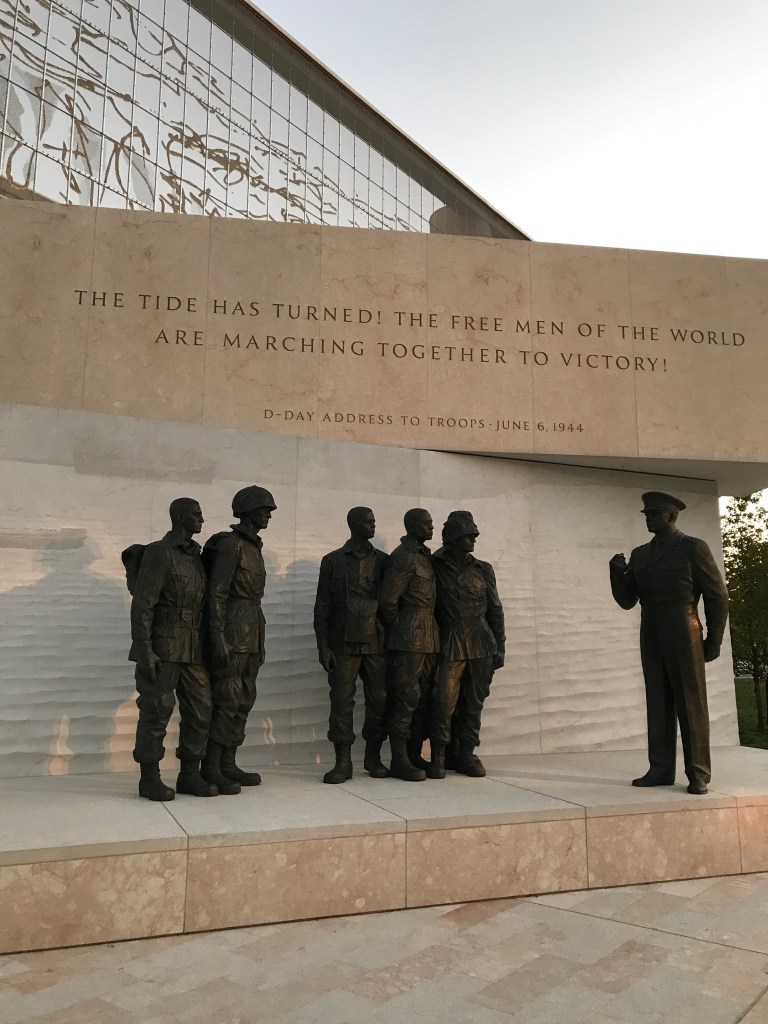
Squeezed in between the National Air and Space Museum and the Department of Education building on Independence Avenue, the recently-opened Dwight D. Eisenhower Memorial attempts to place the thirty-fourth president in the same category of national leadership as Washington, Lincoln, and others deemed worthy of monuments in the nation’s capitol. Indeed, the pink limestone of the Eisenhower memorial faintly echoes the red granite of President Franklin D. Roosevelt’s own memorial. But where the FDR memorial sits serenely on the Tidal Basin alongside shrines to Thomas Jefferson and Martin Luther King, Jr., the Eisenhower memorial jockeys for space in the crowded urban landscape just to the south of the National Mall. 

As the memorial itself makes abundantly clear, Eisenhower earned his own place in American history as much through his service as supreme Allied commander Europe during World War II as his subsequent presidency. Ike was indeed FDR’s most important military commander during the war – though probably not his most indispensable one, an honor that likely goes to Gen. George Marshall – shepherding the single largest and most critical military operation of the war through to its successful completion. Judged on his presidency alone, however, it’s not at all clear that Eisenhower deserves a place in the august company of Lincoln and Roosevelt. 

(Credit: Peter Juul)

That’s not at all to say Eisenhower was a bad or ineffectual president; far from it. But contrary to the Eisenhower nostalgia that’s periodically surfaced over the decades, his presidency simply cannot be considered great or worthy of commemoration in its own right. Many of the domestic achievements he presided over were indeed substantive and substantial, ranging from the advent of the Interstate Highway System and the expansion of Social Security to the creation of NASA and a willingness to exercise federal authority to enforce civil rights laws. However, Eisenhower must share credit with Congressional Democrats for many of these accomplishments, and in any event they appear limited in comparison to those of both his immediate predecessors and successors.

Eisenhower’s foreign policy often receives higher marks and greater contemporary attention, but his overseas record does not do him as much credit as his latter-day boosters imagine. As the historian David Greenberg and others have noted, Eisenhower’s foreign policy relied far too much on covert action and the threat of nuclear war to be truly sustainable or successful. It ultimately proved far too flawed and brittle, leaving Ike’s successor a plethora of intractable foreign policy problems that ran from a revolutionary Cuba and a divided Berlin to an escalating nuclear arms race with the Soviet Union and steadily increasing American military commitment in Vietnam.

Indeed, it’s Eisenhower’s record on Vietnam that’s responsible for much of his inflated foreign policy reputation today. His ultimate refusal to intervene on behalf of the beleaguered French garrison at Dien Bien Phu in 1954 has come to be seen as a salutary example of the sort of leadership that would have steered America clear of intervention in Southeast Asia altogether. But as the historian Fredrik Logevell argues, Eisenhower’s refusal to rescue the French from their desperate military position in Vietnam had less to do with Ike’s own instinctive caution or a personal reluctance to intervene in Southeast Asia than the British government’s lack of enthusiasm for the venture. 

So what explains the persistence of Eisenhower nostalgia? His flawed, though above average presidency can’t justify the recurrent attempts to elevate him to the pantheon of great American political leaders – an impulse now consecrated in bronze and stone. Part of the answer lies in the fact that Eisenhower has come to stand in for a path not taken in American politics, one that carried with it the possibility of a sane and responsible national political party on the center-right. As the actually existing Republican Party drifted further and further to the extreme right with each election, it became tempting to imagine what our national politics might look like if the Republican Party had embraced Ike’s moderate political philosophy rather than repudiated it.

Unlike the rabid right-wing ideologues of his own day, Eisenhower accepted social and economic responsibilities the federal government shouldered during the New Deal and World War II. “Should any political party attempt to abolish social security, unemployment insurance, and eliminate labor laws and farm programs,” he wrote in a now-famous 1954 letter to his brother Edgar, “you would not hear of that party again in our political history. There is a tiny splinter group, of course, that believes you can do these things… Their number is negligible and they are stupid.” Eisenhower called this political program “Modern Republicanism,” in effect a form of conservatism that sought to preserve and even strengthen recent reforms rather than dismantle or abolish them. 

(Credit: Peter Juul)

But Ike himself bears significant responsibility for the fact that his own political ideas failed to take hold within his own party. While president, Eisenhower neglected to establish any real political constituency within the Republican Party for his brand of moderate conservatism. When doctrinaire conservatives seized control of the party in 1964 and nominated Sen. Barry Goldwater of Arizona for president – an ideologue who blasted Eisenhower’s policies as a “dime store New Deal” – Ike put up weak and ineffectual resistance. Nor did Eisenhower provide steady support for moderate alternatives like Governor William Scranton of Pennsylvania, whom Ike had encouraged to enter the race and stymie Goldwater’s bid for the nomination but then refused to publicly back. 

In the end, Eisenhower couldn’t be bothered to mount even a perfunctory defense of his own self-proclaimed political principles. Still, it’s hard to imagine that the country wouldn’t have been better off had Ike managed to make Modern Republicanism a going political concern. Perhaps he simply lacked the political acumen necessary to redefine the outlook of an entire party, or perhaps he simply lacked the necessary personal motivation to do so. Either way, the prospects for a sane center-right politics in the United States grew steadily bleak and never recovered.

Ike’s lack of concern with the fate of moderate conservatism stands in stark contrast with his persistent support for American military involvement in Vietnam. As President Lyndon Johnson waded deeper into the conflict from 1965 onward, Eisenhower constantly advised in favor escalation and against withdrawal both in private and in public. He stated that he “had no patience with the people who want to pull out of Vietnam at once,” and counseled that winning the war – not sending astronauts to the Moon or building the Great Society at home – should be the nation’s top priority. By 1968, Eisenhower was promising to launch a speaking tour against any presidential candidate who proposed pulling U.S. troops out of Vietnam. 

It’s hard to square Ike the hard-core Vietnam hawk with the quasi-peacenik President Eisenhower that’s trotted out by contemporary progressives whenever there’s a debate over the defense budget. Two speeches Eisenhower delivered as president provide a rationale for painting him as a dove: the “Chance for Peace” speech of April 1953 and Eisenhower’s farewell address in January 1961. The former was given in response to the death of Soviet dictator Josef Stalin the previous month, and remains renowned for Eisenhower’s assertion that every piece of military hardware produced constitutes, “in the final sense, a theft from those who hunger and are not fed, those who are cold and are not clothed.” 

But the text of the speech itself makes clear that Eisenhower considered high levels of defense spending a necessity, not a choice. Soviet policy under Stalin made it so, he contended: the United States and its allies were reacting to a Stalin’s drive to seek security for the Soviet Union at the expense of envy other nation in the world. Indeed, Ike predicated his call for diplomacy on a change in Soviet behavior under its post-Stalin leadership. If defense spending represented a theft from pressing domestic needs, Eisenhower thought it patently justified in the geopolitical context he and the nation faced.

(Credit: Peter Juul)

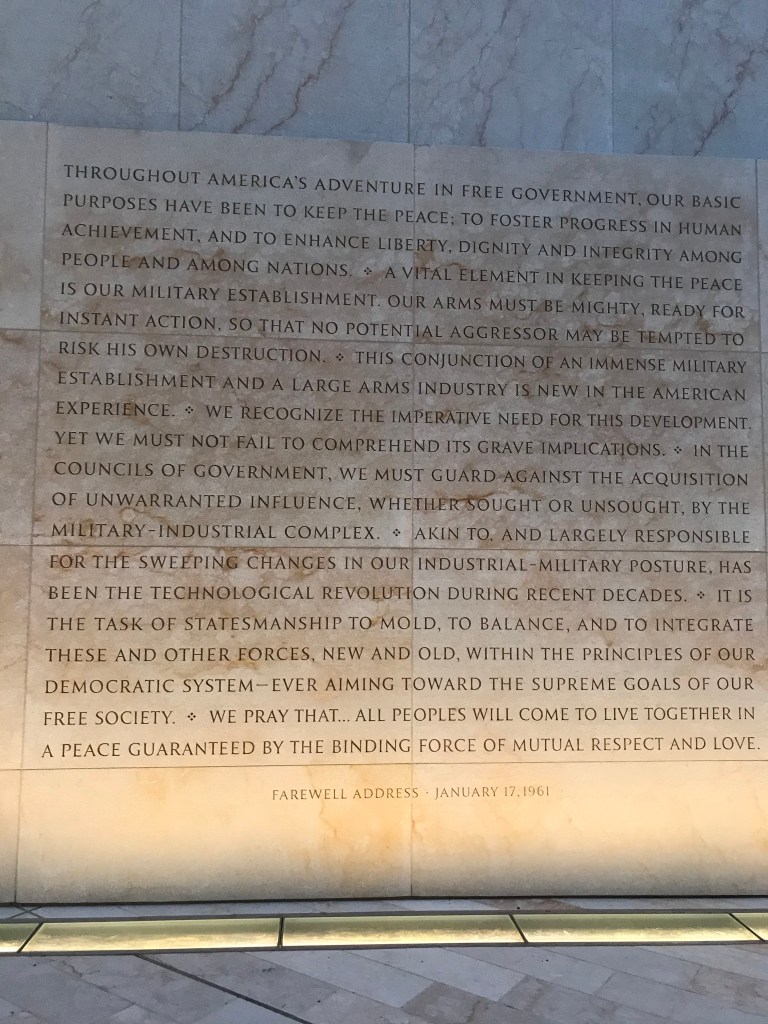
That’s also true of Eisenhower’s most famous presidential peroration, the 1961 farewell address in which he introduced the now-commonplace notion of the military-industrial complex. After his D-Day orders to Allied troops, it’s perhaps Eisenhower’s most well-known public statement. But it’s apparent from the inscription of that address carved into the limestone of Ike’s own memorial that he believed the creation and a maintenance of this new “conjunction of an immense military establishment and a large arms industry” to be absolutely vital. The United States, Eisenhower made plain, had been “compelled to create a permanent armaments industry of vast proportions.” Both he and the nation as a whole recognized “the imperative need for this development.” 

What’s more, Eisenhower’s concerns about the military-industrial complex were part of a broader line of argument that included a warning “that public policy could itself become the captive of a scientific-technological elite.” Scientific research had become too complex and too costly, he argued, only able to be effectively organized and properly funded by the federal government. These two examples fit into the broader theme of Ike’s address, “the need to maintain balance” in public policy. Taken in its entirety, Eisenhower’s farewell address reads less like a jeremiad against the evils inherent in the military-industrial complex and more like a relatively concise expression of Ike’s own personal political philosophy.

While Eisenhower’s presidential reputation continues to suffer from inflation and exaggeration, it’s still hard not to feel a modicum of nostalgia when visiting his memorial in the America of 2020. Ike may not have put up much of a fight for his moderate conservative politics when the going got tough, but there’s no denying that the country as a whole would probably have been much better off if he had. Though there’s much to criticize about Eisenhower’s policies at home and abroad, but he deserves greatest censure for his failure to leave behind a lasting political legacy beyond the national prominence of Richard Nixon.

As for the memorial itself, it fits snugly and unobtrusively in a previously empty patch of land across the street from the National Air and Space Museum. Its metallic tapestry of the Normandy coastline glistens at sunset, reminding passersby of Eisenhower’s true legacy.

(Credit: Peter Juul)

On the Value of Human Connection: A Review of Seneca and Sandel

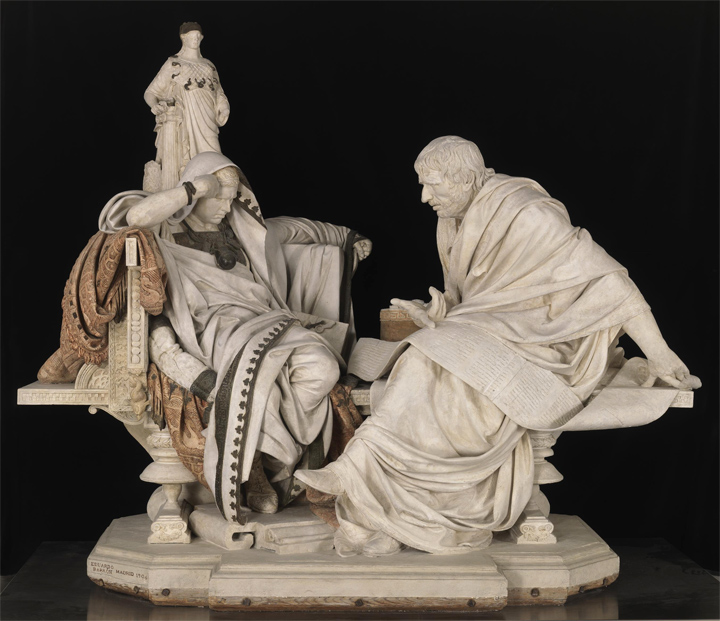
The Restoration of Nero and Seneca by Eduardo Barrón - Museo Nacional del  Prado
Nero and Seneca by Eduardo Barrón (Credit: Museo del Prado)

Review:

On Benefits by Lucius Annaeus Seneca (trans. Miriam Griffin and Brad Inwood)

What Money Can’t Buy: The Moral Limits of Markets by Michael Sandel

When the ancient Roman philosopher and statesman Seneca set out to write his various works of philosophy, it’s unlikely that he could have even imagined the world as it would be two millennia hence. But as an astute observer of the human condition, Seneca probably could have predicted that we’d be dealing with many of the same enduring facets of human nature that he saw in his day and age. That’s readily apparent when reading Seneca’s treatise On Benefits alongside the contemporary academic philosopher Michael Sandel’s recent book What Money Can’t Buy: The Moral Limits of Markets

Despite myriad differences in time and place, both philosophers stress the paramount value of basic human connection for both individuals and society writ large. They both make strong cases that transactional ways of thinking about life corrupt and corrode these connections in ways that eat away at the foundations of shared social life. When transactional and pecuniary mindsets take hold, they argue, we cannot build the sort of intimate personal relationships we crave as individuals or forge the social bonds necessary to pursue the common good. Taken together, these two philosophers remind us that precious little good comes our way when we know the price of everything and the value of nothing.

In his aptly-titled critique, Sandel offers the persuasive and damning argument that we’ve let market and financial thinking crowd out our individual and collective senses moral reasoning. He describes it as a form of pervasive moral corruption that defines our age and leaves us unable to talk meaningfully about the things that truly matter in life. As Sandel makes clear, notions of the common good and other values that money can’t buy persist despite the omnipresence of transactional and financial considerations across society. Through a number of intriguing and compelling examples – the story of a Swiss village that voted against hosting a nuclear waste site when offered financial inducements stands out – he shows how the actions of actual human beings in the real world confound the confident predictions of market theorists. 

This forceful broadside is principally valuable for its clear and convincing moral argument against the intrusion of market logic and financial incentives into every nook and cranny of our personal and public lives. But Sandel sticks mainly to criticism, more concerned with putting market thinking in its proper place and shaking us out of our intellectual complacency than anything else. The case for the common good is present, but Sandel makes it only indirectly and in relief. It’s largely eclipsed by his acute critique of market logic, and in that sense Sandel ironically winds up recapitulating his own case.

Still, Sandel does put his finger directly one of the major challenges of our time. His line of reasoning obliges us to recognize that there are, in fact, things that money can’t – and shouldn’t – buy. As he points out, most if not all of the things that truly matter in life derive their value from the meaning they hold for us and the relationships they embody rather than the price that can be put on them. Intimate relationships with other people – whether friends or romantic partners – rely on beliefs, ideas, and attitudes that can’t be reduced to the transactional logic of the marketplace. “A hired friend,” Sandel notes, “is not the same as a real one.” 

Diagnosing this challenge amounts to a service in and of itself. Sandel opens the door to a wider discussion and lays out the stakes in a clear and concise fashion. But he doesn’t presume to engage in that discussion here, and we have to look elsewhere to find fuller exploration of the ideas he articulates so well.

Fortunately, we have Seneca and his treatise On Benefits to help us dig deeper. For Seneca, benefits represent more than a simple exchange of gifts or favors; they offer crucial insights into human nature. Properly understood, benefits reveal the indispensable role of basic human connection plays in our individual and social lives. Indeed, these connections all but comprise the cement that holds society together. It’s no surprise, then, that Seneca considers “our ignorance of how to give and receive benefits” to be the most harmful of the “wide range of mistakes made by those who live recklessly and without reflection.”

Like Sandel, Seneca harshly criticizes transactional attitudes toward life and human relationships. “No one records benefits in an account book,” he writes, “and then, like a greedy collection agent, demands payment at a set day and time.” According to Seneca, this perspective views benefits as mere loans to be called in when needed or deemed appropriate. It sees human relationships as commodities to be bartered for social advancement, a way to climb the next rung on a social or professional ladder. At best, however, this back-scratching attitude profoundly misconstrues the true nature of benefits. As Seneca reminds us, “The most important things in life cannot be repaid.”

But Seneca is more intent on establishing a full and deep account of the nature and purpose of benefits; his philosophical enterprise goes well beyond Sandel’s in scope and ambition. So what counts as a benefit in Seneca’s eyes? For him, many things define a benefit – none of them material. It “is not the gold, the silver, or any of the other things which are thought to be most important; rather, the benefit is the intention of the giver.” They’re more than that, however: benefits are “a correct deed” that “no violence can nullify,” “a well-intentioned action that confers joy and in so doing derives joy,” and “something to be chosen for its own sake,” among other things.

By Seneca’s lights, then, benefits only occur when they are conceived, given, and received in the right spirit. They embody relationships between individuals, and transcend whatever material form they may take. We bestow benefits when we give to others willingly and with good intentions, seeking nothing but good intentions in return. When recipients accept what they’re given “with a kindly attitude,” they have repaid us and vice versa. It is not simply the exchange itself but the nature of the connection that’s forged between individuals that makes a benefit. In other words, the benefit itself resides in the meanings we confer on it through our intentions in both giving and receiving.

It’s for this reason that Seneca considers benefits to be indispensable to social life. Through “the supreme delight of merely doing good,” the giving and receiving of benefits fosters the individual and civic virtues that make society possible. A transactional approach to life dominated by self-seeking and ingratitude, Seneca tells us, “dissolves and disrupts” the essential human connections and relationships that allow for even a modicum of a shared social life. “Only one thing,” he writes, “protects our lives and fortifies them against sudden attacks: the exchange of benefits.”

That’s because without benefits and the social solidarity they promote – what Seneca terms “fellowship” – individuals would be left to fend for themselves in a brutal and hostile world. Bound together in fellowship by benefits, however, humanity can fend off disease, old age, and other vagaries of fortune. “Remove fellowship,” Seneca warns, “and you will destroy the unity of mankind on which our life depends.” When we transform benefits into commodities, we don’t just spoil the inherent value of the benefits themselves and demean the human connections they express – we sever the social ties that bind us all together.

There’s much more philosophical ground to cover in On Benefits, but the core of Seneca’s argument rests on the supreme value of human connection in our individual and social lives. Benefits, as Seneca understands them, amount to the most visible – and therefore most important – manifestation of these relationships. Moreover, they’re a potent reminder of our shared humanity. Without an accurate appraisal of their significance to society at large, we devalue benefits and the connections they represent at our own individual and collective peril. Put simply, our shared social life cannot exist in the absence of benefits.

It’s a thesis that’s very much in accord with the more narrow arguments made by Sandel in What Money Can’t Buy. Indeed, Sandel echoes Seneca’s emphasis on the proper understanding of gifts in romantic relationships and friendships. He writes that giving gifts to a romantic partner or friend “engages and connects with the recipient, in a way that reflects a certain intimacy.” Like Seneca, Sandel worries that the intrusion of transactional market logic into parts of life it does not belong erodes our ability to “share in a common life” and come to mutual agreement as to what constitutes the common good.

The fact that Sandel can express many of the same concerns Seneca did two millennia ago testifies to the persistence of basic aspects of human nature across space and time. Most notably, for both philosophers basic human connections assume vital importance. That’s largely implicit in Sandel, though occasionally explicit and often present as a background assumption. It’s shot through On Benefits and, for that matter, the rest of Seneca’s body of philosophical work. After all, humanity’s social nature (along with our capacity for reason) remains a central tenet of the Stoic philosophy Seneca practiced. 

But Seneca and, to a lesser extent, Sandel both also speak to humanity’s constant struggle against our own worst instincts and intentions – in particular our misguided tendency to reduce life to material transactions and financial incentives. Seneca, for one, isn’t surprised by this propensity to succumb to such erroneous impressions; as he notes toward the end of On Benefits, ingratitude “is so commonplace that even those who complain about it fall prey to it.” That’s no excuse for failing to bestow benefits, however. “Let us give,” Seneca advises, “even if many of our gifts are in vain.”

In the end, both Seneca and Sandel remind us individuals and societies require more than material incentives and financial logic to succeed. They both call us to think more clearly and carefully about the what really matters in life: our connections and relationships with our fellow human beings.

“Our Coming-of-Age Has Come and Gone”: A Review of Taylor Swift’s “folklore”

(Credit: Beth Garrabrant)

With her atmospheric and impressionistic new record folklore, Taylor Swift hasn’t just made another in a string of superlative albums – she’s created nothing less than a modern masterpiece. It’s an album I’ve been hoping she’d make, one that puts her singular skills as a singer-songwriter on full display. Her unique ability to forge a sense of intimacy and emotional connection with her listers has always been her strong suit; strip away everything else and it’s the fundamental reason why she’s the last true rock star we’re likely to ever see. But with folklore, Swift has managed a unique artistic achievement that ought to cement her place in the storied pantheon of American popular music.

At turns delicate, vulnerable, and pensive, folklore provides an intriguing contrast to last year’s propulsive Lover. Where that excellent album represented a driven and urgent statement of artistic purpose, folklore amounts to an introspective odyssey through many of Swift’s abiding creative concerns and inspirations. As she herself wrote in her introductory note, the album comprises “a collection of songs and stories that flowed like a stream of consciousness.” Swift’s sharp lyrics and affecting vocals dance across a sparse and ethereal sonic landscape, words and music each elegantly complementing one other throughout the album. Reprising and extending a number of its predecessor’s themes, folklore at times proves more emotionally powerful than any of her previous work.

On folklore, Swift tells us that wisdom and maturity cannot be earned without the hurt and heartache that comes with life. These torments are universal, an intrinsic part of the human condition that we can’t escape – but as Swift understands, we can learn much about ourselves from these ordeals and move forward with our lives more than a little wiser for the wear. She repeatedly calls upon evocative imagery of physical scars, wounds, and bleeding to press home her case with the sort of conviction that only personal experience can provide. But Swift doesn’t lament the countless scars she’s picked up over the years; indeed, she welcomes them. If there’s any one overriding idea lurking in folklore, it’s amor fati – the love of fate, a philosophical notion that first surfaced on Lover and which she brings it very much to the surface on folklore.

That’s apparent with the album’s opening track, the aptly-titled “the 1.” Almost immediately, Swift makes clear that she’s approaching her past relationships with maturity and equanimity. She says she’s “doing good” and has “been saying ‘yes’ instead of ‘no,’” reflecting on a failed relationship without bitterness or remorse. Despite looking back now and musing that “it would have been fun if this romance had lasted, Swift knows digging up the past does no good. But she’s accepted the end of her relationship and learned from the experience, acknowledging that “if you never bleed you’re never going to grow/And it’s alright now.” At its core, it’s a speculative reflection from a woman who appreciates what she’s received from a relationship now past – scars and all.

Indeed, vivid lyrics involving scars, wounds, and bleeding mark a number of folklore’s songs. “You drew scars around my stars/But now I’m bleeding,” Swift’s protagonist tells her youthful love on “cardigan.” She acknowledges feeling “like an open wound” when out at a party after wrecking her relationship on “this is me trying,” while on “hoax” she reminds her “faithless love” that he “knew it still hurts underneath my scars/From when they pulled me apart.” But it’d be a mistake to assume this imagery amounts to a simple metaphor for emotional pain. For Swift, the scars we collect teach us hard lessons about life and help make us who we are. It’s an idea that features prominently on Lover’s title track, and Swift explores it far more fully here on folklore.

Swift also builds her introspective frame of mind through the dreamy soundscapes that accompany her contemplative lyrics. On “mirrorball,” for instance, wispy guitar chords reinforce Swift’s lyrical meditation on the need for personal intimacy amidst the wages of celebrity – especially officious demands that she reflect certain views back at her listeners and critics. While she’ll “show you every version of yourself tonight” and will “change everything about me to fit in,” Swift longs for privacy with the object of her affection. When she’s finally alone, Swift tells him, she can be found “Spinning in my highest heels, love/Shining just for you.” It’s a true measure of Swift’s skill as a songwriter that she can translate her own extremely idiosyncratic encounters with the madness of celebrity into a words that speak to the all-too-common social pressures we all face to conform – not to mention the privacy and intimacy we all seek for ourselves, away from the clamor of the crowd. 

Likewise, Swift’s haunting vocals on “this is me trying” echo her lyrical acceptance of personal responsibility and a faltering attempt to repair a broken relationship. Returning to themes broached on songs like “Afterglow” and “Daylight” from Lover, she acknowledges her own shortcomings while recounting her own struggle to change for the better. “They told me all of my cages were mental/So I got wasted like all my potential,” Swift admits. But she’s now “Pouring my heart out to a stranger” rather than sabotaging herself with alcohol “At least I’m trying,” Swift confesses – and that’s all any of us can do, even if like her we maybe “don’t know quite what to say.”

Swift’s raw and fragile vocals on songs like “seven” amplify her stellar songwriting and lend folklore an exquisite emotional vulnerability. “Are there still beautiful things?” she plaintively wonders, reminiscing about her promise to love a childhood friend “to the Moon and to Saturn.” Elegant guitar and piano work enhances the beautiful pastoral imagery painted by Swift’s graceful lyrics, gently guiding us through a bittersweet recollection of youth and a friend whose face she can no longer recall. But it’s enough for her that this memory and the emotions it conjures up will be “passed down like folk songs” through the ages.

Then there’s what Swift calls her “teenage love triangle” trilogy, consisting of the songs “cardigan,” “august,” and “betty.” Swift manages to pack a lot into roughly thirteen minutes of music, providing a complex and nuanced take on the follies of youth as told through divergent accounts of a doomed summer affair and its aftermath. Teenagers may not be quite so idiotic as we think, but they’re still prone to the dumb mistakes and false hopes she tenderly describes from the other woman’s perspective in “august.” 

In an attempt to apologize and win back his significant other, the cheating boyfriend James earnestly explains on “betty” that “I’m only seventeen, I don’t know anything.” It’s not so much that young people frequently make stupid choices, Swift implies, so much as they’re bound to screw up – often spectacularly. As she noted in a recent interview, they need to bleed in order to learn, grow, and mature,: “I think we all have these situations in our lives where we learn to really, really give a heartfelt apology for the first time. Everybody makes mistakes, everybody really messes up sometimes.”

But it’s “invisible string” that’s without doubt folklore’s finest track – and quite possibly the single best song Swift has they written. It’s both something of a spiritual sequel to “Lover” and as sublime an expression of amor fati as we’re likely to hear. Swift somehow proves more than able to distill a number of her animating passions – intimacy, vulnerability, and maturity, among others – into a watercolor daydream four minutes and thirteen seconds long. Above all, though, it’s an affecting love letter to fate and everything it brings.

That’s evident from the buoyant guitar picking that opens the song. Swift begins painting with a technicolor palette, moving from greens and teals to blues to golds as she follows the thread of her fate as it leads to the present. Fate’s companion time assumes various guises throughout the song, at once “curious,” “mystical,” and “wondrous.” It gave Swift “no compasses, gave me no signs” and insisted on “Cutting me open, then healing me fine.” But time also “Gave me the blues and then purple-pink skies/And it’s cool/Baby, with me.” For all that fate and time put her through, Swift remains profoundly grateful that they led her to where she is today: “Hell was the journey but it brought me heaven.”

But fate didn’t just lead Swift to her current relationship. It protected and matured her along the way, pulling her “Out of all the wrong arms,” encasing “all of my past mistakes in barbed wire,” and putting “Chains around my demons/Wool to brave the seasons.” Moreover, Swift no longer has any time for resentments and has grown out of immature feuds. In the past, she acknowledges, “Cold was the steel of my axe to grind/For the boys who broke my heart” – but “Now I send their babies presents.” After stepping into the daylight on the final track of Lover, on “invisible string” Swift is able to more clearly see the “single thread that, for better or worse, ties you to your fate.”

If “invisible string” ranks as folklore’s stand-out track, it’s “epiphany” that strikes the deepest emotional chords. A slow, swelling organ gives way to Swift’s diaphanous vocals as she relates the story of her grandfather hitting the beaches of Guadalcanal as a marine in 1942. With the next verse, Swift’s lyrics establish a compelling correspondence between service on the frontlines of World War II and medical workers on the frontlines of the COVID-19 pandemic today. Both situations exact costly emotional tolls: “And some things you just can’t speak about.” It’s an effective and moving juxtaposition, one that gives voice to the extreme stresses and raw emotions inherent in confronting our own mortality under desperate circumstances – and how we seek some sort of escape, however brief, “To make some sense of what you’ve seen.”

Two more brooding tracks round out folklore, peace” and “hoax.” On the former, Swift’s long-standing sense of insecurity resurfaces to haunt her once again.  Over an insistent electronic pulse, her quavering vocals let her romantic partner know that she’s “a fire and I’ll keep your brittle heart warm/If your cascade, ocean wave blues come.” But while Swift would “give you my sunshine, give you my best,” she’s well aware of what she brings to a relationship – the bad as well as the good. She can’t honestly promise the object of her affection a peaceful or quiet life since “the rain is always gonna come if you’re standin’ with me.” It’s a song that attests to the mature themes Swift dives into on both Lover and folklore.

Swift’s lyrical skills shine on “hoax,” where the song’s upbeat, tinkling piano riff provides a stark contrast to her melancholy verses. “Don’t want no other shade of blue but you,” she ruefully acknowledges. “No other sadness in the world would do.” Her erstwhile significant other knows she still feels the sting of her past emotional wounds, “But what you did was just as dark.” No matter how painful or difficult it may be, however, Swift recognizes that this relationship simply can’t continue and admits defeat in her effort to maintain it:

My only one

My kingdom come undone

My broken drum

You have beaten my heart

But that’s just part and parcel of Swift’s overall message on folklore. However much we want to escape from the hurt and sadness life throws our way, we can’t avoid it. But if we endure it to the best of our abilities, we’ll find ourselves wiser and stronger for the experience. We can even learn to love our fate, since for better or worse it brings us to wherever we happen to wind up at any particular moment. It’s hard for me personally to listen to folklore – and “invisible string” in particular – without recalling the aphorism attributed to the early Greek founders of the Stoic school of philosophy about a dog leashed to a cart: our canine companion can either struggle in vain against the direction of the cart or happily follow its course. That’s how these philosophers conveyed the notion of amor fati, the thread that runs through folklore as a whole and ties it together. 

With folklore, Swift has both pulled together an introspective classic and firmly secured her place as an artist and songwriter of the highest rank. She’s managed both feats by relying once again on her unsurpassed abilities as a singer-songwriter to create an impressionistic and ethereal record that builds on and expands many of the issues and questions explored on Lover and, indeed, throughout her career. Swift plumbs the depths of universal themes inherent in the human condition on the album: acceptance, maturity, and fate. Ultimately, folklore stands on its own a brilliant record that demands close and mindful listening.

As she often does, Swift reminds us to attend to what really matters in life – and accept the scars and wounds we’ll inevitably pick up along the way. That’s something we ought to remain mindful of as we endure the omni-crisis of 2020, a rolling and kaleidoscopic disaster that shows no sign of letting up anytime soon. At very least, Swift tells us, we have to try. After all, if we never bleed we’ll never truly live.

The Unappreciated Genius of Neil Armstrong: A Review of James Hansen’s “First Man”

Credit: NASA

Review:

First Man: The Life of Neil A. Armstrong by James R. Hansen

Before filmmaker Todd Douglas Miller called attention to it in his superlative 2019 documentary Apollo 11, few people had probably seen one of the few photos taken of Neil Armstrong on the Moon. A tuft of hair sticking out of his Snoopy cap, a beaming Armstrong looks euphoric in the photograph shot by fellow astronaut Buzz Aldrin just after the pair returned to the lunar module Eagle at the end of their moon walk. The almost giddy awe apparent in Armstrong’s eyes and grin stands in contrast to the reserved public persona Armstrong cultivated both before and after Apollo 11’s historic journey.

More than anything else, though that single photo captures both the enigma and the genius of Neil Armstrong – though historian James Hansen’s detailed authorized biography First Man: The Life of Neil A. Armstrong certainly comes close. Brimming with prolific quotations from his own correspondence with Armstrong, his family, and his NASA colleagues, it’s as close to an autobiography of Armstrong as we’ll ever get – assuming Armstrong didn’t leave an unpublished manuscript stashed somewhere among his personal effects. Though occasionally weighed down by workmanlike prose and a dutiful obligation to transcribe the details of official reports almost verbatim, First Man makes it clear that Armstrong’s laconic professionalism made him the right choice to be the first human to set foot on the Moon.

As Hansen makes clear, Armstrong’s reticence was simply part and parcel of his personality from an early age. From siblings and high school classmates to NASA colleagues and superiors, those in Armstrong’s orbit invariably describe him as preternaturally calm and deliberate in his thinking and actions. Both his brother and a high school friend, for instance, observed that Neil only engaged in activities “on his terms.” Armstrong’s NASA colleagues would later use similar language to describe him, with Apollo 8 commander Frank Borman contending that Neil’s quiet and conscientious nature meant that “when he said something, it was worth listening to.” Likewise, Buzz Aldrin called Armstrong “certainly reserved, deep, and thoughtful. He would not utter things that would have the potential of being challenged later because of their spontaneity.” Apollo-era flight director Gene Kranz was more straightforward: “He had the commander mentality.”

Critics then and now mistakenly took Armstrong’s reserve as a sort of aloof detachment at best and an engineer’s blockheaded unwillingness to contemplate the meaning of humanity’s first voyage to another world at worst. But it was that very sense of equanimity that enabled Armstrong to keep cool under pressure throughout his career as a test pilot and astronaut. It allowed him to keep Apollo 11 in perspective, seeing it mainly as a job to be done rather than dwelling on the epochal nature of the mission. From a technical perspective, these qualities made Armstrong an excellent choice to command Apollo 11. For all its literary shortcomings, Hansen’s detailed account demystifies what’s become an easily misunderstood core aspect of Armstrong’s personality.

But the real insight from Hansen’s biography rests in how Armstrong’s innate reserve made him the right man to take humanity’s first step on another world. Indeed, NASA leadership recognized that Armstrong’s “soft-spoken” character mattered more than his technical skill as a pilot when it came to making the decision of whether he or the Aldrin – who, according to flight director Chris Kraft, “desperately wanted the honor and wasn’t quiet in letting it be known” – would be the first astronaut on the lunar surface. However, even these wider considerations don’t adequately capture what made Armstrong the right person to be the first man on the Moon.

Thanks to Armstrong’s unwillingness to delve into the meaning and import of his own mission, we’ve all been able to fill in the canvas of Apollo with our own interpretations of this stupendous event. As frustrating as it’s been to journalists and writers then and since, Armstrong’s steadfast reticence has meant that discerning the meaning of Apollo became truly shared enterprise in the years and decades that followed that one small step of July 20, 1969. Those of us lucky enough to witness Apollo 11’s fiftieth anniversary celebrations on the National Mall last year can testify to the ways in which American society and humanity as a whole have collectively discussed and deliberated about the meaning and significance of our first journey beyond our home planet. 

That’s not to say that Armstrong was a cipher – far from it. As Apollo 11 command module pilot Michael Collins recalled, Armstrong was not so much unable to reveal his innermost thoughts to others as he was generally unwilling. Armstrong’s own personal take on the meaning and import of Apollo materialized only rarely; during a pre-launch press conference, for instance, he “tentatively” (in Hansen’s words) suggested that humanity was going to the Moon “because it’s in the nature of the human being to face challenges. It’s by the nature of his deep inner soul. We’re required to do these things just as salmon swim upstream.” That answer may not have satisfied the skepticism of the novelist Norman Mailer, reporting on the mission for Life magazine, but it provides an intriguing humanistic context for Armstrong’s now-immortal first words on the lunar surface: “That’s one small step for [a] man, one giant leap for mankind.” 

Despite the faint intimations of humanism implied by this memorable expression – though Armstrong claims not to have given his statement much thought before setting down on the Sea of Tranquility – the first human to set foot on another celestial body refused to impose his own understanding of this epochal event on the world or the future. It was left up to us to determine the meaning of it all, with Armstrong merely providing us with the opportunity to do so. Though Hansen puts all these pieces of the puzzle on the table, he never really puts them together. He only weakly gives a sense that they constitute parts of a bigger picture, but the fact that Hansen collected them all in one place remains a significant achievement. In the end, though, it’s clear from Hansen’s account that NASA chose the right astronaut for the job.

Hansen understandably devotes nearly all of his narrative – some ninety percent – to Armstrong’s life up to his departure from the astronaut corps in the early summer of 1970. Armstrong himself briefly held a position as the NASA official in charge of advanced aeronautical research and development before leaving government altogether in 1971. He then took up a professorship at the University of Cincinnati for the rest of the 1970s before serving on government commissions (like the investigation into the space shuttle Challenger disaster in 1986) and corporate boards until officially retiring the early 2000s.

Reading Hansen’s brief sketch of his post-lunar life, however, it’s hard to avoid the conclusion that Armstrong had some difficulty adjusting to life after the Moon. After all, just what does the first man on the Moon do with the rest of his life? While Buzz Aldrin’s public struggle with alcoholism and depression began shortly after he and his two fellow astronauts exited their post-mission quarantine in Houston, Armstrong appears to have faced his own mild form of existential drift in the years and decades that followed his return to Earth. That sense of restlessness comes across in Hansen’s account of the end of his marriage to his first wife Janet in the late 1980s, when Armstrong grew indecisive about his own substantial time commitments – and failed to make enough time to sustain their own relationship.

Indeed, of the three Apollo 11 astronauts Michael Collins seems to have had the best post-mission experience. After briefly serving as assistant secretary of state for public affairs, Collins became the first director of the National Air and Space Museum and presided over its opening in 1976. His memoir Carrying the Fire stands as perhaps the best – and certainly most literary – account of what it was like to be an astronaut during the early days of human spaceflight.

That obviously does nothing to detract from Armstrong’s storied career or his dual achievement of being the first person to set foot on the Moon and, consciously or not, allowing us to discover the meaning of that one small step for ourselves. Armstrong’s refusal to impose his own interpretation on the events of Apollo 11 then or later stands in stark contrast to the incessant demands for didactic, black-and-white interpretations that we constantly hear today. Saturated in social media, it seems as if we want to be spoon-fed superficial explanations of the happenings that swirl around us as quickly as possible. 

With his own innate quiet reserve, however, Neil Armstrong gives us a different model to follow. We’d do well to emulate his considered reticence and refuse to indulge in the sort of simplistic moralism about current affairs that marks so much of our day-to-day lives. More importantly, in so doing we’ll give ourselves the time and space needed to come to shared and individual senses of meaning about events we encounter. In the end, Armstrong’s example reminds us that calm deliberation can take us far – even all the way to the Moon.

The Rolling Stones and the Wages of Boredom

We live in an unprecedented season of boredom

Not the familiar kind of ennui we all find ourselves experiencing from time to time, but a sort of existential tedium that’s been imposed upon us by the need to contain the ravages of a deadly virus. It’s not that there aren’t ways to endow this tedium with a sense of purpose, but as a society we’ve failed to avail ourselves of any of them – a failing magnified by our inability to cope constructively with the devastating social and economic consequences of the pandemic. While that’s due mainly to a disastrous absence of political leadership of any kind at the highest level, we each bear our own share of responsibility for slipping so unthinkingly into the deep and pervasive collective malaise that’s filled the ensuing void. 

Strangely enough, the soundtrack most relevant to our stay-at-home monotony was written and recorded some five decades ago by the Rolling Stones. Listening to the Stones at this particular moment of shared boredom, it’s not hard to pick up on the overwhelming sense of anomie and listlessness that courses through much of the band’s work. It’s this undercurrent of aimless anxiety that provided the Stones with their creative animus – and what makes the music they made at the height of their powers in the 1960s and 1970s so apropos in our own era of ennui. 

This motivating torpor comes through loud and clear on the band’s first major success, the appropriately titled “(I Can’t Get No) Satisfaction.” The distorted fuzz of Keith Richards’ languid opening riff provides a fitting prelude to the myriad frustrations with the modern world listed by Mick Jagger. Fueled by the maddeningly contradictory messages he hears from consumer advertisers and an exasperating inability to satiate his sexual desire, Jagger’s central compliant revolves around a state of existential ennui that feels uncannily parallel to that resulting from our own coronavirus confinement. Same goes for “Get Off My Cloud,” another early-era Stones classic in which Jagger describes living in an apartment “on the ninety-ninth floor of my block” and sits “at home looking out the window/Imagining the world has stopped.”

But the band’s animating tedium only truly comes to a head with its seminal 1968 album Beggars Banquet. There, the Stones give full license to the underlying boredom that drives their music. That starts with “Sympathy for the Devil,” where the Stones explore the depravity that results from eternal indolence. It’s as if the sophisticated Satan crafted by the Stones has nothing better to do with his time than cause trouble across human history. For him, this death and destruction amounts to a mere game – though one whose true nature eludes his human audience. An aura of decadent menace surrounds the devil as he demands “some courtesy, some sympathy, and some taste” should the listener ever encounter him. “Use all your well-learned politesse,” he warns, “or I’ll lay your soul to waste.”

Going deeper into the album, the band’s general malaise becomes even more apparent. “No Expectations” and “Dear Doctor” deliver a slow, lazy laments, while on “Jigsaw Puzzle” Jagger “waits so patiently/Lying on the floor.” He’s “just trying to do my jigsaw puzzle/Before it rains anymore.” But it’s on the relatively up-tempo “Street Fighting Man” where the Stones best express their restless boredom. Ostensibly a paean to violent political revolution, the song amounts to an outpouring of aimless frustration when there aren’t any better ways to spend one’s time. (Indeed, boredom often leads to risky and self-destructive behavior.) The narrator claims he personifies disturbance and will “shout and scream, I’ll kill the King I’ll rail at all his servants.” In the end, though, street fighting is nothing more than a release of pent-up energy – in “sleepy London town,” after all, there’s no other way to alleviate boredom “except to sing for a rock and roll band.”

From there on out, it’s only a question of how far the Stones can be driven in their quest to take the edge off their collective listlessness. That’s apparent on songs like “Stray Cat Blues,” an encomium to morally dubious sexual desire on Beggars Banquet, and “Midnight Rambler,” a first person blues narrative about a serial killer on the prowl from Let It Bleed. This ennui-driven exploration of the darker reaches of the human condition probably hits its apotheosis with “Brown Sugar,” the sublime opening track on the Stones’ 1971 masterpiece Sticky Fingers. 

It’s clear in retrospect that the band’s malaise had nowhere more extreme to take them after this depraved triumph, but their languid restlessness still marks the rest of Sticky Fingers. “Did you ever wake up to find,” Jagger wonders on “Sway,” “A day that broke up your mind/Destroyed your notion of circular time?” Likewise, “Can’t You Hear Me Knocking” exudes agitated ennui from its nasty opening chords through Jagger’s snarling delivery to the concluding jam session between Richards and then-Stones guitarist Mick Taylor. “Dead Flowers,” the album’s penultimate track, makes explicit at least one of the wages of terminal boredom: the desperate stupor of heroin abuse.

Indolence continued to fuel the Stones creatively well into the 1970s. On the opening track of 1972’s Exile On Main Street, for instance, Jagger confesses “the sunshine bores the daylights out of me.” The disco-inflected hit “Miss You” from 1978’s Some Girls alludes to the anxious tedium involved in “hanging on the phone” and “sleeping all alone” while waiting for the call of an erstwhile lover; several songs on 1980’s Emotional Rescue hit similar themes as well. Despite the band’s own licentious lifestyle at the time, there’s a certain theatricality behind their musical decadence. Dissolute aspects of their own personal lives aside, it’s as if the Stones suggest that we shouldn’t take them too seriously.

Two of the band’s most well-known songs suggest that’s the case – and provide rays of light amidst the boredom-generated doom and gloom that characterizes much of their work. Perhaps the Stones’ best song, “Jumpin’ Jack Flash” reassures us that after all our trials and tribulations – including a “spike right through my head” – “it’s all right now, in fact it’s a gas.” More to the point, “It’s Only Rock ‘N Roll (But I Like It)” gives the game away: for the Stones (or Jagger at least), rock and roll can’t solve our existential problems – but it is an exceptionally enjoyable way to fill our time and dispel our boredom, if only temporarily.

That’s why the sonic landscape the Stones created five decades ago is so appropriate for our own day and age. With an endless and aimless lockdown nurturing ennui on a massive scale, perhaps it’s only fitting that a band so fueled by the need to relieve its own boredom gives us our most relevant soundtrack. Indeed, the Stones captured the zeitgeist with their most recent single, “Living in a Ghost Town” – and showed how their enduring preoccupation with existential indolence and what to do with it remain potent today. 

But as much as the Stones once pushed the boundaries of good taste and cultivated a well-earned reputation for raising hell while plumbing the depths of debauchery with their music, they also leave us with good reason for optimism. We may be confined to home indefinitely and bored to tears, but it’s all right: we’ve got rock and roll, and it’s a gas, gas, gas.

Two Roads to the Same Destination: The Rise of Gated Community Politics on Both Left and Right

We live in the age of gated community politics.

This form of politics rests on the idea that the United States and individual American citizens can sequester themselves from the world and each other. It exemplifies a particular sort of moral and political isolationism, an abdication of solidarity with and our obligations to our fellow citizens and humanity as a whole. Whether expressed in a right-wing idiom or a left-wing one, gated community politics both reflects and stimulates the collapse of social trust that’s needed to create and sustain stable and successful societies. Gated community politics  denies the possibility of a shared national life, thriving on and amplifying solipsism while dissolving the bonds that link fellow citizens to one another and the world at large.

Both variants of gated community politics are founded on fundamentally misguided understandings of human nature. That’s most obvious with the right-wing version promoted by President Trump, based as it is on excessive pessimism about human nature and the need to build literal walls to cut ourselves off from others. But it’s equally present on the progressive left in the guise of romantic and utopian beliefs about human nature that find substantive expression in calls for foreign policy “restraint” and, more recently, abolish or defund the police at home. Together, privileged left-wing idealism and entrenched far-right pessimism aid and abet one another, each in their own way stimulating and encouraging the gated community mentality that distorts the way we think about politics and society.

Whatever fine distinctions can be drawn between these two ways of thinking about human nature, in the final analysis they’re two roads to the same destination: the gated political community, isolated from one’s fellow citizens and the rest of humanity. Along the way, these two caricatures of human nature flatten our thinking about our shared human experience and leave us unequipped to deal with the complex, messy realities of politics and human life. No matter our starting point, when we adopt either of these misconceived notions of human nature we’re almost certain to wend our way to the gated political community.

It’s easy to recognize the gated community mentality on the right, particularly in the form of President Trump’s “America First” foreign policy and his repeated pledges to build a literal wall on the border with Mexico. An excessive pessimism about human nature undergirds the right-wing school of gated community politics. It sees humanity as inherently egocentric and misanthropic, with every person and every nation out to take advantage of everyone else. We must therefore shape our own behavior accordingly, building walls to keep others out and arming ourselves to the teeth to keep them away. What’s more, we must do our utmost to take advantage of others before they take advantage of us first.

President Trump’s unfulfilled promise to build a wall on the border with Mexico easily stands as the most obvious and concrete manifestation of right-wing gated community politics. In its attempt to keep undesirables out of the country, the wall both literally and symbolically aims to turn the United States into a gated community. Indeed, it’s hard to imagine a better synecdoche for the gated community worldview than President Trump’s “impenetrable, physical, tall, powerful, beautiful, southern border wall.”

Appeals Court Rejects Trump's Diversion of Military Funds for ...
Credit: Doug Mills, New York Times

But the gated community mentality is far more important as the engine that drives President Trump’s “America First” approach to foreign policy, an attitude that sees the nations of the world as always and everywhere trying to exploit of the United States. In this view, alliances become protection rackets and international trade a matter of exploitation rather than instruments of shared security and mutual prosperity. Witness President Trump’s recent complaint that the “European Union has ripped this country off so much” when it comes to trade, for instance, or his repeated insistence that allies in Europe and Asia pay for American military protection.

In terms of policy, “America First” relies almost solely on coercion. Throwing up tariff barriers and threatening to withdraw from alliances unless other member nations pony up protection money only reflects the narrow-minded, self-serving, and ultimately fearful impulses that lay at heart of the gated community politics on the right. At best, this form of politics cultivates a sense of aggrieved indifference toward the rest of the world. It dissolves any sense of international solidarity among like-minded nations, and reduces the United States to a bystander on the world stage. In consequence, it constitutes both a moral and practical evasion of the complex and difficult realities of international politics. More than anything else, though, the practice of right-wing gated community politics amounts to a self-fulfilling prophecy of the highest – and worst – order by acting as if the world really operates in the way President Trump and his fellow-travelers believe it does.

If President Trump actively aims to remake the nation as a gated community, his professed opponents on the progressive left seem happy to reach the same destination – albeit by a different path. Cloaked in idealistic rhetoric, progressive gated community politics are no less destructive than its right-wing mirror image of the bonds of solidarity on which society depends. Nor is it any less founded on fundamentally misguided notions of human nature than its counterpart on the right. 

Indeed, progressive gated community politics rests on romantic and utopian ideas surrounding human nature. Believing humanity to be intrinsically innocent but corrupted by a base and sinful society, at the end of the day progressive gated community politics yields a blithe and privileged anarchism that frequently finds adherents among the relatively well-off upper-middle-classes of society. With a healthy dose of condescending solipsism, this mentality asserts that the American society and the United States constitute the main root of all that’s wrong with the world in some way, shape, or form. As a result, society itself – and “primacy” and “liberal hegemony” in the foreign policy context – must somehow be “dismantled” or otherwise destroyed to clear the way for the progressive utopia that will inevitably and ineluctably emerge from the ruins.

Ultimately, however, this worldview amounts to a counterfeit altruism that can only be offered by those who have the means to exempt themselves from its consequences. It’s no exaggeration to say that this atavistic mode of progressive politics fosters the very conditions that lead to the demand for gated communities in the first place. The emergence of the progressive gated community mentality marks an enormous regression in supposedly left-wing political thinking, a renunciation of the ideals of solidarity and shared citizenship in the name of an allegedly higher morality.

This moral and political isolationism can be found first and foremost in the foreign policy doctrines that fall under the rubric of “restraint.” Advocates of “restraint” assume that a wholesale American retreat from the world will lead to an improvement in the existing state of international affairs. Presuming the exercise of American military power to be the root of all international problems, advocates of “restraint” assume that the removal of said military power can only have salutary consequences for global security and stability. Leaving our erstwhile allies in Europe and Asia to fend for themselves against regional powers like Russia and China will therefore cause few if any problems, allowing the United States to focus more intently on its own domestic problems and inaugurate a new age of global cooperation on problems like climate change. Dismantle “liberal hegemony,” in other words, and the world will see something close to an Edenic efflorescence of peace and security.

But while advocates of “restraint” clothe themselves in righteous rhetoric and take a very different rhetorical path than that taken President Trump and “America First,” their preferred foreign policy approach winds up in the very same gated community. In both cases, America finds itself isolated and alone in the world after it severs the moral and political bonds that attach it to its friends and allies around the globe. Presenting themselves as mere realists, advocates of “restraint” foster a gated community mentality on the left that’s strikingly similar to its counterpart on the right. This gated community may appear more welcoming, but it nonetheless remains walled off and separate from the rest of the world in its own pernicious way.

On the domestic front, notions of foreign policy “restraint” find an uncanny analogue in newly-fashionable calls to defund – or even abolish – local police forces. Even more than advocates of “restraint,” progressives aiming to starve law enforcement of resources exemplify the romantic and utopian assumptions about human nature that animate the gated community mentality on the left. This worldview takes for granted the notion that the state and society themselves constitute the major source of societal dysfunction and, more crucially, that the diminution of public authority does not and cannot logically entail a rejection of the ideals shared citizenship and solidarity necessary for a diverse and variegated society to function even at a most basic level.

Progressive ideologues on the Minneapolis City Council, for instance, voted to abolish the metropolitan police department – but provided three members of the council with private security details in the weeks surrounding the vote that followed the apparent murder of an unarmed man at the hands of the police. The head of the city council has even argued the desire for basic public protection against crimes like armed robbery “comes from a place of privilege.” Likewise, the progressive residents of one Minneapolis neighborhood have found themselves contending with growing public disorder – but refuse to call the police or cooperate with prosecutors on ideological grounds, even when compelled to turn over the keys to their cars at gunpoint. Meanwhile, gun violence on the North Side of Minneapolis continues to take its toll, with over a hundred people shot and eight killed since Memorial Day. Residents of this less well-off neighborhood can catalogue their fair share of problems and issues with the police, but look askance at calls by local progressive ideologues to defund or abolish law enforcement.

From the Balkans in the 1990s to Iraq and Syria in the 2000s and 2010s, the world has seen this movie before and it doesn’t end well. In the absence of a legitimate public authority able to enforce the law and provide a modicum of security, people will seek safety in the confines of narrower and narrower social units based on allegedly primordial identity markers. Those with means to afford private security will avail themselves of it, withdrawing from society and into their own heavily-policed gated communities. Nor does community security provided by one’s neighbors – an alternative offered by more radical police abolitionists – avoid the gated community problem, and indeed may make matters worse. As the philosopher Michael Walzer notes, this sort of “neighborly surveillance” has its own long and sordid history from Calvinist Geneva and Puritan England to Revolutionary France and Maoist China. 

A provincial governor in Heilongjiang has his hair brutally shaved and is forced to bow for hours after being accused of bearing a resemblance to Mao Zedong.
Credit: © Li Zhensheng/Contact Press Images

Above all else, though, progressive gated community politics stands as a repudiation of solidarity with one’s fellow citizens and, indeed, the rest of humanity. Its practitioners amputate these indispensable common bonds and fail to envisage – much less consider – the predictable consequences involved. In the pursuit of an idyllic illusion, they unwittingly propose to slip back into circumstances uncomfortably akin a Hobbesian state of nature. Though it may start from vastly different and much more idealistic (though no less misguided) suppositions about human nature than its right-wing equivalent, progressive gated community politics merely charts a different path to the same destination.

So how can we escape the politics of the gated community?

We can start by recognizing the practical implications inherent in both progressive and right-wing manifestations of gated community politics. Both reassure us that we’ll reap nothing but benefits when we cut ourselves off from our fellow citizens and loosen our ties to the rest of humanity. In reality, these forms of politics do nothing so much as dissolve the bonds of solidarity and shatter the individual public-spiritedness so vital and necessary to functioning societies. They constitute a retreat into moral and political isolationism, and an abdication of responsibility and concern for one another as citizens and human beings. In its progressive incarnation especially, gated community politics results in both an ethical and physical withdrawal from society by those who can afford their own protection. As the great labor and civil rights leader Bayard Rustin put it in the late 1960s, left-wing “pseudo-revolutionaries” who advocate utopian political romanticism but “can retreat into their universities and suburbs” when faced with the practical consequences of their worldview “deserve special condemnation.”

More importantly, we can reject the fundamentally misguided beliefs about human nature posited by proponents of gated community politics on both left and right. Neither the excessive pessimism of the gated community right nor the romantic utopianism of the gated community left evince much (if any) contact with living, breathing human beings in all their complexity and contradiction. Nor do they reveal much real regard for actually existing people. A certain solipsism prevails in gated community politics on both ends of the political spectrum, as if the world does not exist outside the mental constructs about human nature they’ve built for themselves. Indeed, these erroneous understandings of human nature serve only to flatten the human experience, reducing it to caricatures that invariably lead to either self-fulfilling prophecies or perverse outcomes. The end result of the gated community mentality across political and ideological lines is an inability – or an outright refusal – to think about complicated moral, political, and policy questions that by their very nature can’t be forced into the procrustean bed of ideology.

To truly escape from the prison of gated community politics, though we need more balanced and refined beliefs about human nature. These ideas would acknowledge the positives and negatives of human nature in concert, considering its strengths together with its weaknesses. As a matter of fact, philosophical and religious traditions have been conceiving and elaborating such ideas throughout human history. The ancient Stoics, for instance, developed a subtle and sophisticated view of human nature that involved the use of reason on behalf of the common good of both the particular society in which we happen to live as well as humanity as a whole. But they also understood that it’s foolish to expect no one to ever do wrong or wrongdoers of any and every stripe not to exist; indeed, the Stoic philosopher-statesmen Seneca and Marcus Aurelius took pains to remind themselves and their literary interlocutors to anticipate encountering such mistaken and misguided people in daily life. This ancient school of philosophical thought offered a nuanced and reflective account of human nature that aimed to delineate it, detail its requirements, and, perhaps most importantly, why we so often fail to live up to it.

Equestrian Statue of Marcus Aurelius, Capitoline Museums, Rome (2019). Credit: Peter Juul

Other philosophical and religious traditions can offer similar accounts of human nature. Though Thomas Hobbes, for instance, remains best known for his deeply pessimistic speculative description of the state of nature, he also contended that humanity could emancipate and protect itself from this dire predicament by delegating authority to a overwhelmingly powerful sovereign state. But the specifics of these ideas about human nature remain less important than the fact that it’s possible to have fully developed philosophical or religious understandings of human nature without resorting to the distorted and simplistic views that undergird the gated community mentality. We’d all be better served by adopting the richer accounts of human nature these ways of thinking offer.

The task before us today, however, mostly involves holding the line against the moral and political isolationism offered by gated community politics across the political spectrum. It’s a difficult assignment, but looking forward it will prove vital to maintain the bonds of common humanity and shared citizenship necessary for any society to function – and function well. These bonds are under active assault from both right and left: the former holds an extremely pessimistic view of human nature that denies such bonds exist outside an exceedingly narrow confines, while the latter advances romantic and utopian notions that only serve to dissolve these bonds. In the end, they’re merely different roads to the same destination: the gated community.

But we can still turn back the tide of gated community politics if we reject the misguided and false understandings of human nature on which it relies. Instead, we can and should adopt and put forward more balanced ideas about human nature that strengthen the bonds of solidarity that unite us with our fellow citizens and humanity writ large. If we shed the moral and political isolationism at its root, then perhaps we can reject the temptations of gated community politics wherever they may emerge.