Making a Difference Again – First Impressions of Star Trek: Picard

“Let me tell you something: don’t. Don’t let them promote you. Don’t let them transfer you. Don’t let them do anything that takes you off the bridge of that ship because while you’re there… You can make a difference.”

Ever since I caught my first episode of Star Trek: The Next Generation over twenty-five years ago, I’ve been a huge Star Trek fanatic. Through thirteen films and seven television series, the show has displayed a faith in humanity and optimism in our prospects that’s conspicuous by its absence in a popular culture soaked with irony and cynicism. Indeed, most other familiar science fiction franchises like Terminator, Blade Runner, and Battlestar Galactica veer toward the dark and ominous in both atmosphere and substance. These dystopian worlds tell us not just that humanity can’t get things right or make progress, but that we’re bound to actively make matters worse if not destroy ourselves and the things that matter most to us in the process.

In this dismal milieu, though, Star Trek’s perpetual optimism andenduring faith in humanity stands apart. This hopeful outlook shines through most clearly in The Next Generation, my favorite among all the series produced to date. That’s in large part due to the character of Captain Jean-Luc Picard, played with aplomb by Patrick Stewart for over three decades. Picard’s nigh-impregnable moral core and ability to express it with remarkable and forceful eloquence grounds The Next Generation’s belief in humanity’s capacity to change for the better.  

So I’m very much sympathetic to complaints and criticisms that the show’s latest iteration, Star Trek: Picard, falls short of the idealism that’s driven Star Trek for more than five decades. As critic Devin Faraci puts it, “it’s become clear that the people running Star Trekthese days want it to be cool” rather than “corny as hell” – and that that desire undermines Star Trek’s core ethos. Beyond question, there’s a real aesthetic dissonance between Picard and its 24th century predecessors. On certain points of style like fashion, for instance, Picard feels more in line with contemporary sensibilities than the admittedly “weird” things we saw on The Next Generation, Deep Space Nine, and Voyager. More important, however, is that Picard takes place in a Federation that’s failed in spectacular ways to live up to the ideals articulated by Captain Picard himself during the halcyon days of The Next Generation.

But that’s precisely why I find Picard so captivating. It’s hardly a groundbreaking observation to note that Star Trek has always crafted its interstellar morality plays in ways that reflect and refract current events and contemporary conditions. The original series, for instance, featured an episode that illustrated the madness of racial prejudice, while The Next Generation demonstrated that historical enemies could become present-day friends by placing a Klingon character on the bridge of the Enterprise and made the Klingon Empire one of the Federation’s closest allies. In “Duet,” Deep Space Nine shows the futility of holding on to hatred and the necessity of forgiveness for even the most heinous crimes.

The list of episodes and storylines could go on and on, but it’s important to recognize that these themes remain nested within Star Trek’s broader optimism about humanity and its future. Appearances to the contrary notwithstanding, Star Trek: Picard falls directly in line with this tradition. If Picard feels less utopian than its direct predecessors, that’s due to the timely nature of the narrative it tells and the profound questions it sets out to explore. Namely, what do we do when the we’ve failed, the world is broken, and nothing seems to matter any more? What happens when things fall apart in spite of best efforts?

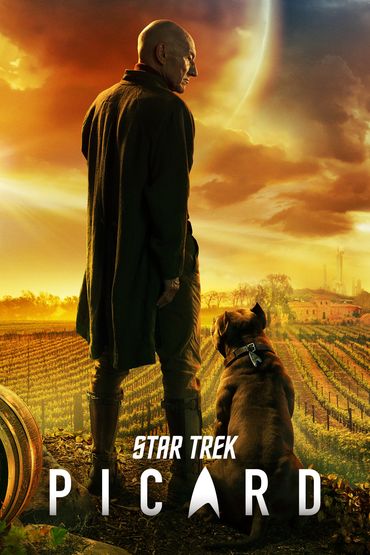
These are the kinds of existential questions Jean-Luc Picard confronts in his eponymous series. When we first come across him again, it’s apparent that Picard isn’t the same confident captain of the starship Enterprise we last saw at the end of 2002’s Star Trek: Nemesis. This Picard has been puttering away in self-imposed exile on his family’s ancestral vineyards for nearly a decade and a half, writing books of history and tending to the vines with help from a pair of former Romulan intelligence operatives Laris and Zhaban (played by Orla Brady and Jamie McShane, respectively) as well as a pitbull terrier named Number One (portrayed by a rescue called Dinero).

The reason for Picard’s retreat soon becomes clear: Starfleet and the Federation have fallen far from the high ideals of The Next Generation era. Asked in an interview with a Federation news media network why he left Starfleet, Picard first quietly and then angrily responds, “Because it was no longer Starfleet!” Indeed, Picard resigned in protest when the Federation failed to live up to its own ideals and canceled the mission he commanded to rescue hundreds of millions of Romulans from an interstellar natural disaster [1]. Haunted by the most profound personal failure of his career and disillusioned with the institutions to which he had dedicated his life, Picard withdrew to his family’s vineyards and walled himself off from a society that, in his view, betrayed its own fundamental principles.

The fallen Federation we glimpse in Picard nowhere near as as bleak as the dystopia depicted, say, Logan. Most importantly, neither the Federation nor Starfleet have crossed the thin and invisible line into permanent dysfunction and despair. By comparison with other fictional worlds, moreover, the Federation remains a fundamentally optimistic place in possession of more or less functional institutions. Paradoxically, however, it’s on this very account that the Federation of Picard feels much more real and visceral than the relentlessly grim and hopeless fictional universes that tend to occupy wide swathes of our popular culture. Given the high esteem in which both Picard and the Star Trek fans held Starfleet and the Federation throughout The Next Generation era, even minor shortcomings in these previously respected institutions lend Picard and its main themes a moral gravity that’s not truly possible in otherwise comparable narrative contexts. When Starfleet abandons Picard’s mission to save the Romulans, for instance, it’s impossible for us to disagree with his lament that he “never dreamed that Starfleet would give in to intolerance and fear.”

Making matters worse for Picard, the rhetorical brilliance and moral force so often on display in The Next Generation failed him at the worst possible time. Hundreds of millions of lives perished as a result, driving Picard into a paralyzing and isolating spiral of self-doubt and second-guessing. Just before his volatile interview halfway through the first episode, his Romulan caretakers take pains to remind Picard of his own character and history. “After so long, sometimes I worry you have forgotten what you did, who you are,” Laris instructs him.  “We have not.” Zhaban provides more friendly counsel: “Be the captain they remember.” 

As Laris and Zhaban insist, Jean-Luc Picard proves one of the best characters available to explore these themes of personal disillusionment and failure. Throwing an individual with such high moral and ethical standards back into a world that has let those standards down in spectacular ways makes for compelling and engrossing drama. What’s more, having Picard navigate this disenchanted environment without the same respect he once commanded – witness the dressing down the head of Starfleet Command gives him when he requests reinstatement – only reinforces the existential questions Picard raises.

Indeed, the first four episodes of Picard go a long way toward providing answers to these questions. In the premiere, it’s Picard’s encounter with Dahj Asha (played by Isa Briones) that spurs him back into action. He quickly discovers that Dahj is the synthetic daughter of the late Commander Data, the android officer and friend who sacrificed himself to save Picard at the end of Nemesis.

Dahj’s own ensuing death at the hands of a secret Romulan death squad propels Picard forward, forcing him to conclude that he still has a moral obligation to act. “She came here to find safety,” he tells Laris and Zhaban. “She deserved better from me. I owe it to her to find out who killed her and why.” When Laris assures him that he asks to much of himself, Picard retorts that “sitting here, all these years” on his family’s vineyards while “nursing his offended dignity” and “writing books of history people prefer to forget,” he “never asked anything of myself at all. I haven’t been living. I’ve been waiting to die.”

This brief dialogue serves as the moral fulcrum for Picard the decorated but disillusioned former Starfleet captain. But it also serves as a manifesto, a clear statement of purpose for Star Trek: Picard the television series. Picard comes to realize that it’s his duty to take action and make a difference as best he can – even if he’s unable to fix everything or even anything that’s wrong with the universe. He understands that his principles don’t allow him to mark time until his inevitable demise, and that they require him to make a difference in whatever small way he can. This rekindled sense of moral purpose Picard balances against and ultimately wins out over his disillusionment and disaffection with Starfleet.

In due course, Picard learns that the particular method involved in creating Dahj also birthed a twin sister, Soji. Intent on protecting Soji from her sister’s fate, he assembles a crew far removed from his old Enterprise comrades and sets out on a rough-and-ready rescue mission. Intriguingly, Picard goes from trying – and failing – to save hundreds of millions of lives on his final Starfleet assignment to trying to save just one life with a small crew of unusual rogues and flotsam. This turn of events echoes a remark Picard made to Data in an episode of The Next Generation: “You’re a culture of one, which is no less valid than a culture of one billion.” One life or a billion; Picard advises us it doesn’t matter how much of a difference we make as long as we do our best to make a difference.

As much as anything else, though, Picard’s process of personal and moral rediscovery reflects Star Trek’s long-standing view on the central value and importance of human connection. It’s Picard’s relationship to Data that catapults him into action, motivating him to seek out and protect Dahj and, later, Soji. As he tells Dahj, “If you are who I think you are, you dear to me in ways that you can’t understand.” In this way, Picard maintains Star Trek’s traditional faith in humanity. It doesn’t do so via abstract and flawed institutions like Starfleet or the Federation, but instead finds grounds for hope in individuals like Picard and the personal relationships he’s forged. What really matters in a world that falls well short of our highest ideals, Picard tells us, are our moral obligations to ourselves and others – especially those we care about.

Without doubt, Star Trek: Picard leaves plenty of room for criticism – much of it justified. Nor is it difficult to understand why the show might prove divisive among long-time Star Trek fans. But the Starfleet without illusions itdepicts betrays neither Star Trek as a whole nor The Next Generation and Jean-Luc Picard in particular. Indeed, Picard carries on the show’s best thematic traditions, dealing with contemporary issues and grappling with the difficult moral questions that lay at the heart of the human condition. It’s hard to believe otherwise after watching Picard tear down a “Romulans Only” sign at a bar and trample on it despite the rather obvious personal danger involved. 

Ultimately, the strengths of Star Trek: Picard far outweigh whatever weaknesses and deficiencies die-hard fans and casual viewers alike point out. Wherever the rest of the series may go – and I’m eager to find out – Picard has already proven itself to be a worthy addition to the Star Trek canon.


[1]  This mission aimed to relocate some 900 million Romulans – the Federation’s oldest enemy – before their home system’s sun unexpectedly went supernova, an event that served as the catalyst for the trilogy of alternate timeline Star Trek films that began in 2009 and starred Chris Pine as Captain Kirk. Starfleet called off the mission after an apparent uprising by synthetic workers helping build the rescue fleet at the Utopia Planitia shipyards on Mars left tens of thousands dead and prompted Federation member worlds to talk of secession rather than continue to rescue operation. As with many things Star Trek, it’s complicated. 

Ad Astra: An Ambitious, Flawed Epic

Image result for ad astra"

Review: 

Ad Astra dir. James Gray (2019)

“To see the earth as it truly is, small and blue and beautiful in that eternal silence where it floats, is to see ourselves as riders on the earth together, brothers on that bright loveliness in the eternal cold – brothers who know now they truly are brothers.”

Things haven’t exactly panned out the way MacLeish predicted. There’s no doubt that the Apollo voyages to the Moon still inspire awe and wonder in people around the world. These expeditions allowed humanity to reflect on its place in the cosmos in ways it could only imagine before. But even if his hopeful prophecy of universal planetary brotherhood failed to materialize in Apollo’s wake, MacLeish at least deserves credit for surfacing the profound existential questions that space exploration provokes and engaging in the sort of serious intellectual reflection these questions demand.

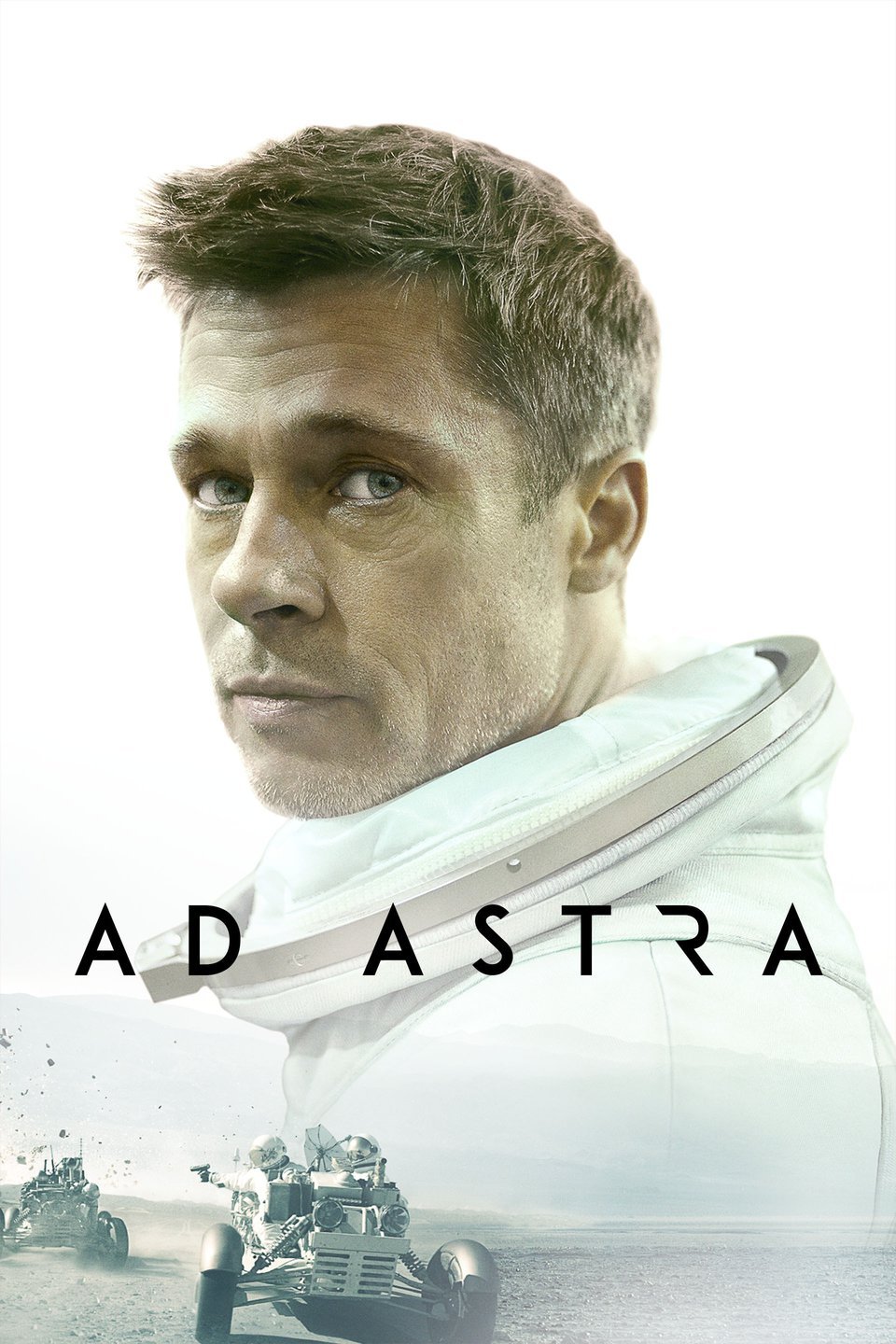
So it is with Ad Astra, an impressive yet flawed epic that wrestles with these big ideas and themes but can’t quite do them full justice in the end. The filmfollows astronaut Roy McBride (played by Brad Pitt) on his journey across the Solar System to retrieve his father from an ill-fated mission to Neptune that’s believed responsible for a series of energy surges that could end all life as we know it. A cold and austere aesthetic undergirds and reinforces the film’s central motifs, as does the Heart of Darkness-style narrative that structures it. But if Ad Astra  ultimately falls just short of what it hopes to achieve, it should not be criticized harshly. Instead, the film should be praised for its ambition and willingness to grapple with enduring and consequential questions.

That ambition starts with the film’s Heart of Darkness narrative structure, laid out early on in the briefing McBride receives from his military superiors at U.S. Space Command. Soon enough, he’s on board a commercial rocket to the Moon to begin his highly-classified mission. Like the Joseph Conrad’s Marlow in Heart of Darkness and Martin Sheen’s Captain Willard in Apocalypse Now, McBride must undertake a grueling and increasingly dark physical and moral journey to the end of civilization and beyond. But where Marlow and Willard went upriver in colonial Africa and Vietnam, respectively, McBride travels beyond human settlements on the Moon and Mars to the outer reaches of the Solar System. In all three odysseys, moreover, the main characters seek out a revered and respected figure gone mad: the deranged colonial official Kurtz in Heart of Darkness, the decorated Special Forces Colonel Walter Kurtz famously incarnated by Marlon Brando in Apocalypse Now, and the legendary astronaut Clifford McBride – Roy’s father, portrayed by Tommy Lee Jones – in Ad Astra.

Beyond the shift in setting to outer space, this father-son dynamic represents Ad Astra’s largest and possibly most intriguing deviation from the Heart of Darkness narrative. After an initial viewing, however, it’s unclear what this particular wrinkle adds thematically, and at times it feels somewhat superfluous given other themes the film works to develop. On a surface level, the film appears to slot this relationship into a well-worn stock narrative of paternal abandonment. Indeed, McBride’s father left his son behind and departed on his ill-fated deep space mission to search for extraterrestrial life some 29 years prior to the start of the film. He later admits, “I don’t want to be my dad.”

It’d be a mistake to view the film’s treatment of this father-son relationship through this rather superficial lens, however. On the contrary, the relationship between McBride and his father drives the action in Ad Astra in ways that prove crucial to the movie’s narrative and wider themes while only landing glancing blows at traditional themes of fatherly neglect. These family ties set the final act of the film into motion, in which McBride defies orders to stay on Mars, hijacks the ship sent to kill his wayward father, and heads out to Neptune for the film’s emotional and thematic climax.

But the father-son relationship also grounds and propels McBride’s own substantial character evolution over the course of the film. When we first meet McBride, he’s remarkably alienated from himself and the rest of humanity. Via voice-over – one of the film’s central narrative conceits and a nod to Apocalypse Now – he tells the us that he’s “been trained to compartmentalize” and it “seems to me that’s how I approach my life.” McBride has clear difficulties relating to other people; he reviews a video message from his estranged wife Eve (played by Liv Tyler), who informs him that “I feel like I’m looking for you all the time trying to connect to you, be close to you and it fucking sucks.”

That’s where McBride stands at the start of the film, and he maintains this isolation from humanity as he travels to the Moon for the first stage of his journey. “All the hopes we ever had for space travel, covered up by drink stands and t-shirt vendors,” he states as he arrives at a lunar colony bedecked with neon advertisements, “Just a re-creation of what we’re running from on Earth.” “Here we go again. Fighting over resources,” he remarks as a running firefight with lunar pirates in the no-man’s-land between the colony and a Space Command base on the far side of the Moon begins.

The further McBride voyages out from Earth, though, the more he sheds this cynicism and grows closer to humanity as a whole. A classified video asserting his father intentionally disabled his ship’s communications leaves him wondering whether what his father discovered broke him or whether he was always broken. After a botched rescue mission that leaves the commander of the spacecraft taking him to Mars dead, McBride sees the same anger and pain he saw in his father in himself and observes that “it keeps me walled off… walled off from relationships and opening myself up and, you know, really caring for someone.” But he admits that doesn’t yet know how to surmount this obstacle.

This moral and philosophical journey accelerates when McBride finds himself traveling alone to Neptune after inadvertently killing the crew of the spacecraft he surreptitiously attempts to board on Mars. In a log entry made en route, McBride admits the “zero-g and the extended duration of the journey is affecting me both physically and mentally. I am alone. Something I always believed I preferred… But I confess it’s wearing on me.” 

Then McBride reaches Neptune and his father’s derelict spacecraft. He boards it, making his way through corridors haunted by flickering lights and floating corpses before confronting his disturbed father. Totally detached from humanity and consumed with his quest to find intelligent life among the stars, McBride’s father flatly states that he never truly cared about McBride, his mother, or anything else back on Earth – or humanity’s “small ideas.” Obsessed with proving that humanity isn’t alone in the universe and unwilling to accept that the data his mission collected proves otherwise, McBride’s father cannot see the reality that what he has been looking for was staring him in the face his whole life.

It’s in this final act that Ad Astra’s weightiest theme fully surfaces: the search for extraterrestrial intelligence and humanity’s place in the universe. This momentous theme comes into focus only erratically and infrequently before it emerges in full force at the film’s climax. Through briefings and video messages, for instance, we’re occasionally told that McBride’s father led an ill-fated mission to scan nearby star systems for signs of intelligent life. Still, it’s admirable that Ad Astra raises these far-reaching ideas as strongly as it does in the end.

Indeed, the realization that humanity must rely on itself in a cold and indifferent universe consummates McBride’s own character evolution. Where his father seeks an escape from humanity in his monomaniacal search for intelligent life elsewhere in the galaxy and mourns his inability to find it, McBride himself grasps the harsh reality of humanity’s ultimate cosmic loneliness. In response to his father’s insistence his son can’t let him fail, McBride tells him he didn’t fail: “Now we know. We’re all we’ve got.”

McBride’s moral and philosophical progress over the course of his journey deeper into space and further away from humanity subtly subverts the traditional Heart of Darkness narrative. Where he starts supremely cynical about humanity and its ability to change its ways for the better, McBride slowly develops a faith in humanity despite the darkness that washes over his voyage. Paradoxically, this budding belief grows in no small part because of the solitude he endures, conveying to him in no uncertain terms the necessity of basic human connection that he previously felt he didn’t need. His encounter and confrontation with his father, isolated and disconnected from humanity, only confirms McBride in his new perspective. As he puts it, his father “could only see what was not there – and missed what was right in front of him.” 

In the end, McBride’s ordeal forces him to rediscover humanity. He quite literally lets his father go after doing his best to bring him back to Earth, leaving him spinning off alone into the vastness of space before riding a nuclear shockwave home. In the film’s final scene, McBride reconnects with his estranged wife and delivers a voiceover monologue (framed as an input to the automated psychological tests that recur throughout) that summarizes his new frame of mind:

I’m steady, calm. I slept well, no bad dreams. I am active and engaged. I am aware of my surroundings and those in my immediate sphere. I’m attentive. I am focused on the essential, to the exclusion of all else. I’m unsure of the future, but I’m not concerned. I will rely on those closest to me, and I will share their burdens – as they share mine. I will live, and love.

In its own flawed and frustrating but compelling way, Ad Astra tells us that we’re all we’ve got – and that that’s more than enough.

Reflections on Taylor Swift, or the Pop Star as Philosopher

Photo credit: Gareth Cattermole/TAS18/Getty Images

“I’ll tell you the truth but never goodbye”

Taylor Swift may well be the last legitimate rock star America ever sees. 

That’s not just a matter of album sales or hit singles, though it did take just one week for her new record Lover to become the best-selling album of 2019. Nor is it simply a question of sold-out concerts, though her 2018 stadium tour became the highest-grossing U.S. tour on record – a title previously held by the likes of the Rolling Stones. Then there’s Lover Fest, a pair of two-day music festivals she plans to play next summer in Los Angeles and Boston. It’s a testament to her place in the pantheon of popular music that Swift is one of the few contemporary musical artists or acts that could pull off this remarkable set of feats.

To be sure, Swift isn’t the only rock star on the scene today – but she’ll almost certainly be the last artist to achieve the sort of widespread societal recognition inherent in the term itself. That’s in no small part due to the fact that Swift rose to prominence in the last days before social media platforms like Facebook and Twitter demolished any remaining semblance of shared experience in American society. When Swift released her breakthrough second album Fearless in 2008, Facebook had around 145 million users and Twitter users tweeted some 300,000 times per day. By the time she released her third album, Speak Now, in 2010, Facebook’s users more than trebled to 608 million and tweets per day reached around 35 million.

Social media platforms cannot be held only or solely responsible for wider trends that predated their rise. Instead, they merely accelerated a process of wider societal fragmentation and cultural decoherence already well under way at the time these platforms emerged. But as the linguist and social commentator John McWhorter put it, in roughly 2008 and 2009 the likes of Facebook and Twitter “revolutionized the American conversation about, well, everything.” Though others like social psychologist Jonathan Haidt and technologist Tobias Rose-Stockwell argue these seismic shifts occurred a couple of years later, there’s little doubt that social media platforms wrought havoc on our national life and helped snuff out the possibility of a common national culture moving forward.

The music industry proved no exception, but Swift didn’t just luckily stumble upon on the last moments before social media devoured society whole. Her body of work displays a level of consistent quality and quantity that parallels that of the golden age of rock in the late 1960s and early 1970s. Then, god-like bands like the Rolling Stones and Led Zeppelin strung together a series of masterpiece albums like Sticky Fingers and Physical Graffiti over a number of years. Prince was perhaps the last artist to pull off such a run, releasing nine albums from his 1979 self-titled record to 1988’s Lovesexy. Likewise, Swift has recorded and released quality albums almost every two years since her own self-titled debut in 2006, only allowing an extra year to pass between 2014’s 1989 and 2017’s reputation despite the demands of massive global concert tours.

That’s the why. The real reason Swift has become the last of the dying breed of rock stars is that she cultivates a real sense of intimacy with her listeners. In part that’s because at her core she’s a singer-songwriter in the tradition of Joni Mitchell, Carly Simon, and, in more recent decades, Sarah McLachlan and the Lilith Fair crowd of the 1990s. By her own account, Swift is a “confessional songwriter” and her latest album as “very, very autobiographical” with “moments of extreme catchiness and moments of extreme personal confession.” As she told the audience at her NPR Tiny Desk concert in October 2019, “songwriting is really just like a cathartic, therapeutic thing for me.”

Strip everything else away from her music, and that’s who she is and what she does – and it’s a large part of why she’s earned her place in the pantheon of popular music. It comes through clear in whatever genre she’s writing in: country, pop, and even the electro-detour of reputation. Her songs simply work in ways that are increasingly rare, and do so on their own merits. As she herself remarked in a recent interview with Rolling Stone, “Singing about something helps you to express it in a way that feels more accurate. You cannot, no matter what, put words in a quote and have it move someone the same way as if you heard those words with the perfect sonic representation of that feeling.”

In her songs, Swift bares her vulnerabilities and insecurities to her listeners and invites them to share their own vulnerabilities and insecurities with her. This intimacy can be called contrived or affected, but that’s the opposite of the truth. It may be intimacy at a distance, but it’s a legitimate and very real intimacy nonetheless. Through her own emotional sincerity, Swift allows her listeners to open themselves up emotionally in a culture made callous by unbridled irony and cynicism. She gives her listeners license to feel and express their deepest fears and hopes in ways that would otherwise leave them exposed to ridicule or worse in everyday life. More than anything else, it’s this very real human connection that bonds Swift and her fans.

Swift forges these bonds through the way she tackles universal themes and subjects that strike at the heart of the human condition. She possesses the rare ability to translate her own personal experiences of longing, heartbreak, and self-doubt into a universal idiom that speaks to fundamental human needs for intimacy and connection amidst the often painful struggles inherent in life. As Swift herself put it when discussing the title track from Lover at her Tiny Desk concert, “in life you accumulate scars, you accumulate hurt, you accumulate moments of, you know, learning and disappointment and struggle and all that, and if someone’s going to take your hand, they’d better take your hand scars and all.”

It’s this gift that drives her popularity and staying power, pushing her work beyond the ephemeral and all but guaranteeing her a long career. Her most recent album, Lover, testifies to this singular skill and puts it on full display. The album is also a perfect distillation of the themes and questions Swift has contemplated over the course of her career. Swift understands that we all long for intimacy, we all suffer heartbreak, and we all fall short of our own ideals far more often than we’d like to admit. Lover succeeds in plumbing the depths of these universal human experiences while carrying forward many of the thematic through lines that Swift has explored over the course of her career.

That’s apparent in the introductory note she penned for the album. It’s something of a manifesto for the album itself, her music in general, and her relationship with her listeners. This statement reveals an artist fully aware of what she aims to achieve and why she aims to achieve it.

It’s worth quoting it at length:

In life, we grow up and we encounter the nuanced complexities of trying to figure out who to be, how to act, or how to be happy. Like invisible smoke in the room, we wonder what kind of anxiety pushes you forward and what kind ruins your ability to find joy in your life. We constantly question our choices, our surroundings, and we beat ourselves up for our mistakes. All the while, we crave romance. We long for those rare, enchanting moments when things just fall into place. Above all else, we really, really want our lives to be filled with love.

She continues, advising and encouraging her listeners:

I’ve decided that in this life, I want to be defined by the things I love – not the things I hate, the things I’m afraid of, or the things that haunt me in the middle of the night. Those things may be my struggles, but they’re not my identity. I wish the same for you. May your struggles become inaudible background noise behind the loud, clear voices of those who love and appreciate you. Turn those voices up in the mix in your head. May you take notice of the things in your life that are nice and make you feel safe and maybe even find wonderment in them. May you write down your feelings and reflect on them years later, only to learn that all the trials and tribulations you thought might kill you… didn’t. I hope that someday you forget that pain ever existed. I hope that if there is a lover in your life, it’s someone who deserves you. If that’s the case, I hope you treat them with care.

These messages and themes may seem simple, but in reality they convey a remarkably astute assessment of the human condition and the shared hopes, desires, and anxieties that constitute it. They strike at the most important and profound questions many of us face in life, and address some of the most intense and meaningful experiences many of us will ever have. For Swift herself, these messages ultimately constitute a clear sense of artistic purpose that comes through forcefully on Lover.

That starts with the title track. As a song about the most basic and intimate of human connections, “Lover” sets the tone for the entire album. To all appearances, the song hits a series of happy notes about a serious romantic relationship. But it’s also shot through with self-doubt and uncertainty, as the chorus indicates: “Can I go where you go?/Can we always be this close?” Though the listener presumes the answer of Swift’s object of affection will invariably be yes, the song itself provides no assurances. Swift puts herself in a position of extreme emotional vulnerability, declaring her own feelings about “this magnetic force of a man” with no guarantee her romantic partner will reciprocate in any way. Swift herself explained that she “wanted the chorus [of ‘Lover’] to be these, like, really simple existential questions that we ask ourselves when we’re in love. ‘Can I go where you go?’ is such a heavy thing to ask somebody. ‘Can we always be this close?’ has so much fear in it – but so does love.”

This awareness of an inherent connection between love and fear as well as the knowledge of the ever-present risk of emotional hurt haunts Lover. Indeed, Swift repeatedly exposes her own self-doubts and anxieties throughout the album and invites her listeners to conclude that the pursuit of genuine human connection and intimacy requires facing one’s own fears and insecurities directly.“I love you, ain’t that the worst thing you ever heard?” she asks a new romantic partner on “Cruel Summer,” for instance. With 80s-style synthesizers and a persistent beat propelling her forward on “The Archer,” Swift wonders, “Who could ever leave me, darling…/But who could stay?” Even when relationships are going strong in songs like “Cornelia Street,” Swift hopes she’ll never lose her partner and that their relationship will never end. If it does, she says, the reminders of heartbreak will prove so intense – it’d be “the kind of heartbreak time could never mend”- that she’d “never walk Cornelia Street again.” Then there’s the brutal, uncertain, and protracted emotional process involved in the end of a relationship described by Swift on the aptly-titled “Death by a Thousand Cuts.” All this on a record she rightly considers “a very, very happy, romantic album.”

Above all else, though, Lover reflects Swift’s growing maturity and self-assurance. As she put it when describing the title track, “When young adults go from living in their family to then combining their life with someone else, that’s actually like the most profound thing.” On the ethereal sonic landscape of “Afterglow,” for instance, she takes responsibility for the fiery end of a relationship and regrets hurting her partner in the process: 

Why’d I have to break what I love so much? 

It’s on your face

And I’m to blame

I need to say

Hey, it’s all me, in my head

I’m the one who burned us down

But it’s not what I meant

Sorry that I hurt you

Likewise, on “I Forgot That You Existed” Swift champions moving on from difficult emotional situations and cultivating a healthy sense of equanimity toward life’s struggles. The right attitude to develop toward those who wrong you, she advises, “isn’t love it isn’t hate/It’s just indifference.” Moreover, Swift lets her listeners know there’s a certain joy – a sentiment expressed elsewhere on songs like “I Think He Knows” – that comes from moving past whatever trials and tribulations we might experience, even if these conflicts won’t ever see any satisfactory resolution. Indeed, Swift later proclaims her own version of amor fati (“love of fate”) on “Paper Rings”: “Honey without all the exes, fights, and flaws/We wouldn’t be standing here so tall.”

But Swift’s thematic apotheosis comes on Lover’s final track, “Daylight.” Even more than the title track, this elegant song captures the spirit of the album itself and provides a stellar summation of Swift’s own artistic ambitions. In “Daylight,” she comes to terms with her own flaws and mistakes, discovers the sort of the intimacy we all seek, and steps into the future with an assurance and confidence born of experience. “There are so many lines that I’ve crossed unforgiven,” she admits; “I wounded the good and I trusted the wicked/Clearing the air, I breathed in the smoke.” She expand on this acknowledgment of personal mistakes and missteps in her Rolling Stone interview, saying that it bothers her “looking back at life and realizing that no matter what, you screw things up. Sometimes there are people that were in your life and they’re not anymore — and there’s nothing you can do about it. You can’t fix it, you can’t change it.”

If she’s made the litany of mistakes she lists in the first two verses, however, Swift has forgiven herself and moved on: “Threw out our cloaks and our daggers because it’s morning now/It’s brighter now.” Self-acceptance allows her to cast aside her illusions of what she once thought about love as well as her own self-doubt that she’d ever find the intimacy she seeks. “I once believed love would be black and white/But it’s golden/Like daylight,” she sings. Swift has finally  made the genuine human connection she’s yearned for, and no longer wants to look at or think about anything or anyone else. Our past and our pain don’t define us, Swift counsels. But to truly move forward with our lives and achieve the sort of intimacy she’s discovered and that we all seek, “You gotta step into the daylight/And let it go/Just let it go.” 

So much more could be said about Lover, enough to launch a million think-pieces and academic papers. Swift’s view of romance as a religion in songs like “False God,” for instance, or the recurrence of the color blue in songs like “Cruel Summer,” “Miss Americana and the Heartbreak Prince,” “Paper Rings,” and “Afterglow” provide fertile ground for even deeper exploration. At its core, however, Lover remains an earnest meditation on universal themes of love, human connection, intimacy, desire, vulnerability, happiness, and maturity – subjects that define much of the human condition itself. That this sort of contemplation can occur in the context of a best-selling pop album testifies to Swift’s talents as a songwriter and ambitions as an artist.

Ultimately, though, Swift’s music in general and Lover in particular serve as a reminder of the things that truly matter in life: the genuine, intimate connections we make with our fellow human beings. Swift prompts us to focus on the people and things we love, and to devote our time and energy to them rather than our mistakes, our pain, or our anxieties. We can do that best when we accept ourselves and let go of the hurt and fears that hold us back. 

As Swift herself reminds us with her parting words, “You are what you love.”

Reflections on the 50th Anniversary of Apollo 11

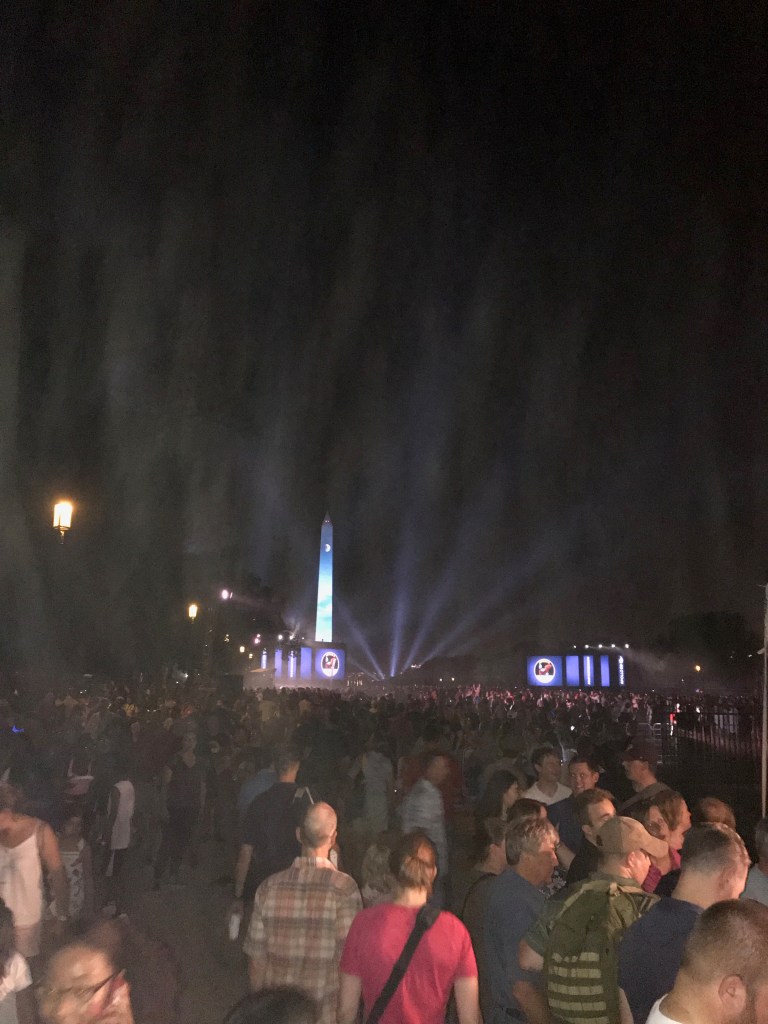
On two sweltering summer nights last July, an estimated half a million people gathered on the National Mall to commemorate the fiftieth anniversary of the Apollo 11 Moon landing with a spectacular multimedia presentation involving a life-sized Saturn V rocket projected on the Washington Monument’s east side. I was one of those tens of thousands who assembled on the Mall on the night of July 19 to catch the second of three showings. Even though the sun had slipped below the horizon some two hours prior to the 10:30PM showing, my fellow congregants and I were still drenched with sweat from the still-high heat and oppressive humidity. These stifling conditions didn’t deter any of us from showing up to witness a unique, likely once-in-a-lifetime experience.

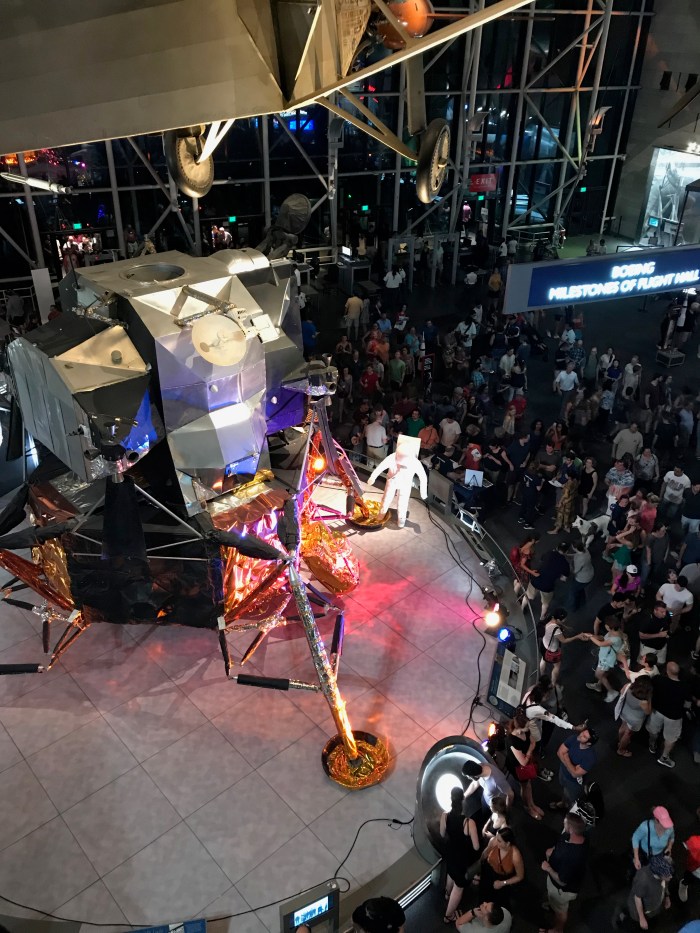
The day of the actual anniversary, July 20, proved equally suffocating weather-wise. But it still didn’t stop me and others from attending festivities on the Mall or waiting in line to get into the National Air and Space Museum for a night of celebrations amidst the relics of the space age. As the exact moment of when humanity took its first steps on another world approached, people thronged the museum’s central Milestones of Flight Hall. A collection of balloons strung together to resemble a Moon boot hung from the ceiling, slowly descending to the floor in sync with Neil Armstrong’s first small step onto the grey powder of the Sea of Tranquility.

It’d be a mistake to see these celebrations as just a commemoration of a single and singular historical event. They were that, but they were also something more: the sort of shared, inspirational experience that’s uncommon in this day and age. These festivities didn’t just mark the precise time and date that the first humans walked on the Moon, they testified to the fact that the Apollo Moon landings still fire America’s national imagination – and humanity’s as well. Indeed, crowds for the Washington Monument show were triple what the organizers at the National Air and Space Museum expected despite heat warnings from the National Weather Service. This tremendous public response testifies the fact that Apollo no longer exists merely as history; it has slipped into the rarefied air of myth and legend.

Why?

Much of it has to do with the passage of time. As technology advanced and slide rules gave way to smartphones and artificial intelligence, Apollo became all the more impressive an achievement. In recent years and decades, moreover, we’ve become accustomed – or inured – to holding powerful computers in the palms of our hands. Ordinary household computers, for instance, can now easily simulate the once cutting-edge operations performed by Apollo Guidance Computer.

NASA engineers, administrators, and astronauts made Apollo happen without the sort of technology we take for granted today. Without Apollo, however, information technology systems – in particular, the transition from computers relying on vacuum tubes to those running on much faster and more compact integrated circuits – may not have developed at the speed or scale it did. As a matter of fact, demand from Apollo accounted for around 60 percent of all integrated circuits made in the United States from 1962 to 1967. Thanks in large part to Apollo, the price of semiconductor chips fell from $1,000 a piece at the start of the 1960s to just $15 per chip by the time Neil Armstrong, Buzz Aldrin, and Michael Collins blasted off for the Moon at the end of the decade.

Over the decades, moreover, various myths and legends accreted accreted around Apollo and the early American space program in general. Regardless of their veracity – and I once witnessed John Glenn vigorously defend the honor of his fellow Mercury astronauts against their portrayal by Tom Wolfe – books like The Right Stuff and films like Apollo 13 built a popular mythology that surrounds NASA and the early American space program to this day. The fact that phrases like “the right stuff” and “Houston, we have a problem” have slipped into our national vernacular attests to this legendary status. Even fictional presentations like The Martian do their fair share to contribute to this mythology; what else is The Martian but Apollo 13 on Mars?

More fundamentally, though, the accretion of legends around Apollo tells us that we haven’t done anything nearly as impressive either as a nation or a species since. For all their practical benefits, the technological achievements of the post-Apollo decades ring hollow by comparison. Smartphones and social media, ever-greater computing power and the Internet have all proven useful economically if not necessarily advantageous to society as a whole. These technologies do not provoke the same sense of wonder that even images beamed down the International Space Station still do, and any appreciation of wider societal progress we may have derived from these technologies gets lost amidst the gnawing suspicion they have done more harm than good. 

If the passage of time gives us a deeper perspective on Apollo, Apollo itself continues to give us all a new perspective on our own home planet and humanity’s place in the cosmos. This shift in perspective resembles nothing so much has the ancient Greek and Roman philosophical exercises christened “the view from above” by the French scholar Pierre Hadot in more recent times. The ancient Stoic philosopher-emperor Marcus Aurelius, for one used the view from above repeatedly in his Meditations, at one point reminding himself that“the Earth in its entirety is merely a point in space, and how small is this corner of it in which we have our dwelling” (4.3).

Marcus and other ancient philosophical practitioners used the view from above to take a cosmic perspective and reflect on the ultimate transience and impermanence of all things – including their own lives. While they had to rely on their own imaginations to contemplate this perspective, however, Apollo provided humanity writ large with a similar perspective on our place in the universe. Images like Earthrise (shot by the crew of Apollo 8) and the Blue Marble (captured by Apollo 17) remain as breathtaking as the days they were taken in 1968 and 1972. Once presented with the sight of a fragile blue orb hanging in the vastness and vacuum of space by Apollo, it became impossible for humanity to look at our home the same way we once did.

The fact that actual human beings traveled to and set foot on another world added even more to this perspective shift. From the Pale Blue Dot portrait of Earth taken by Voyager 1 some four billion miles away to the stunning panoramas routinely relayed down by the Hubble Space Telescope, our robotic explorers have certainly given us their own set of awe-inspiring images,. Impressive as these images are, however, these robotic explorers and orbiting observatories that take them cannot imbue their images with the same sense of shared experience that astronauts – fellow human beings, for all their flaws and limitations – can. Apollo 11 command module pilot Michael Collins described leaving Earth orbit, for instance, as “a totally different sensation than being in the race track of an earth orbit. I am conscious of the distance this time, not speed, and distance away from home” (p. 380). It’s hard for a robot, however well-programmed, to convey that impression back to those of us back home on Earth.

It’s only a slight exaggeration to say that Apollo was as much a massive, publicly-funded philosophical exercise as anything else. But it was the active involvement of human beings that transformed this already-impressive feat of science and technology into a Promethean achievement worthy of legend. Apollo showed America at its very best, and expanded our horizons as both a nation and as a species. The fact that Apollo realized our national and human aspirations in such a spectacular way is a major reason why it remains lodged in our national consciousness to this day.

On a darker and more ominous note, however, Apollo’s mythological status reflects a deepening disillusionment with the digital revolution it helped spark. There’s no doubt that information technology has advanced by leaps and bounds in the five decades since Apollo 11 touched down on the lunar surface. Yet that same explosive growth of information technology and computer networks in recent years and decades hasn’t yielded the same sort of intangible societal benefits or new perspectives on humanity’s place in the universe that Apollo did. While Apollo still fires our imaginations, we’ve come to surmise that our contemporary digital era has merely made our lives more convenient at too high a cost. 

Indeed, most of us benefit far more from information technology in our everyday lives than we did from sending astronauts to the Moon in the 1960s. Though the Internet as we know it barely existed a quarter century ago and smartphones have only been around less than half as long, our society has grown so dependent on these technologies that it’s hard to imagine our daily existence without them and the services they provide. But as convenient as they’ve made our lives, information technology and computer networks have also conjured up a pervasive atmosphere of perpetual anxiety, interpersonal distrust, and foreboding about the future that narrows our national horizons and eats away at the basic fabric of our society like an acid. In the end, it’s hard to escape the suspicion that the digital revolution has served to fuel our worst impulses and instincts rather than aiding the better angels of our nature.

That’s certainly the fear that’s been expressed in popular culture, where an ambience of pessimism and cynicism has shadowed information technology and computer networks for decades. The contrast between Star Trek’s relentless confidence in the future – or even the more tempered optimism of the Mass Effect video game series – and the digital despair of countless cyber-dystopias ranging from Snow Crash to The Matrix, for instance, could not be more stark. A general sense of digital dread permeates the popular culture of the digital era, made worse by repeated and often overwrought alarms raised by the likes of Stephen Hawking, Bill Gates, and Elon Musk about the allegedly existential threat posed by the ultimate digital technology: artificial intelligence.

AI fear-mongering aside, perhaps the real reason Apollo still looms so large today is that it was a public achievement all Americans had a part in. Where information technology and computer networks increasingly compartmentalize society and stoke division, everyone could partake in a great national and human adventure to land astronauts on the Moon. The irony here is that billionaire tech giants like Musk and Jeff Bezos eagerly claim the mantle of Apollo for their own private fantasies of space colonization despite the fact that (excellent PR notwithstanding) they do not come anywhere close to constituting the sort of grand public enterprise that Apollo did – and still does, even in the ever more fragmented society in which we all live.

That’s the ultimate reason why Apollo has become a myth and legend today; in a very real sense, Apollo took us all to the Moon. Apollo not only served to measure the best of America’s own national energies and skills, it shifted humanity’s overall perspective on itself and its place in the cosmos. It represented the triumph of national imagination and purpose toward an end that benefited not just the United States, but humanity as a whole. In this day and age, however, it seems impossible to many of us that the United States or the world write large could even do such a thing. So with each passing year, Apollo becomes more and more a myth and legend: a story we tell ourselves of what we could once do but no longer can.

Apollo’s Lasting Legacies

Review: 

American Moonshot: John F. Kennedy and the Great Space Race by Douglas Brinkley

Apollo 11 dir. Todd Douglas Miller (2019)

First Man dir. Damien Chazelle (2018)

Fifty years ago this summer, humanity left its first footprints on another world when American astronauts Neil Armstrong and Buzz Aldrin gently climbed down the ladder of the lunar module Eagle and stepped onto the surface of the Moon. Beyond the stalwart efforts of the Smithsonian National Air and Space Museum, NASA-sponsored events at other science and technology museum across the country, and an upcoming three-part PBS documentary, this momentous milestone approaches with little official fanfare. But the Apollo moonshot and what the historian Douglas Brinkley aptly terms the “great space race” remain indelible cultural touchstones for Americans and, indeed, many around the world.

Brinkley himself has become part of the unofficial public commemoration of Apollo 11 that’s steadily picked up steam over the past year. This output not only includes his new book, American Moonshot: John F. Kennedy and the Great Space Race, but also the films First Man, director Damien Chazelle’s dramatization of Neil Armstrong’s journey from X-15 test pilot to first man on the Moon, and Apollo 11, a breathtaking documentary of the mission pulled together by director Todd Douglas Miller from footage left neglected for decades in the National Archives.

It’s no coincidence that both First Man and Apollo 11 close with President Kennedy’s stirring September 1962 case for Apollo made at Rice University in Houston – and it’s President Kennedy’s space policy that American Moonshot explores. Though it doesn’t reach the same heights as Brinkley’s accounts of the conservationist policies of Theodore and Franklin Roosevelt (The Wilderness Warrior and Rightful Heritage, respectively), American Moonshot effectively argues for Kennedy’s personal importance in the politics and policies that set America on a course for the Moon in the early 1960s. Kennedy’s extraordinary competitive streak and faith in the fundamental tenets of mid-twentieth century liberalism – as Brinkley puts it, “America, the richest nation, doing big projects well” – drove his early and enthusiastic support for America’s space program in general and Apollo in particular.

But as Brinkley makes clear, the spirit of Apollo didn’t simply consist of high-flown rhetoric. The actual moonshot required a marshaling of national resources and purpose on a scale the likes of which have not been seen since. President Kennedy didn’t conjure Apollo into existence through sheer will; after all, he told NASA administrator James Webb in November 1962 that he was “not that interested in space” for its own sake. Instead, Kennedy saw space exploration both as a critical component of his own liberal nationalist vision and a central front in the Cold War with the Soviet Union. 

Indeed, national prestige – as refracted through both America’s own domestic politics and its geopolitical competition with the Soviet Union – laid squarely at the heart of Kennedy’s initial and ongoing support for Apollo. As Brinkley notes, “Kennedy was a prestige maven when it came to space-related issues… Refusing to be first in space, JFK would say, telegraphed the wrong signals to Third World countries debating the political virtues of democracy over communism.” Or as Kennedy himself put it on that sweltering September day at Rice in 1962, Apollo would “serve to organize and measure the best of our energies and skills, because that challenge is one that we are willing to accept, one we are unwilling to postpone, and one which we intend to win, and the others, too.”

Yet Brinkley only partially manages to capture the grandeur of Apollo and the “great space race.” Nor does he entirely fulfill the book’s promise to situate Apollo in the sweep of mid-twentieth century American liberalism, despite tantalizing morsels and passing references scattered throughout. Brinkley leaves intriguing lines of thought unexplored, failing to dilate on the idea that both Kennedy and his successor Lyndon Johnson saw the space race with the Soviet Union as both “a challenge to the American democratic way of life” and a “dare to rise to greatness.”

Here, Brinkley misses an opportunity to more clearly show that today’s progressives need not fear constructive forms of nationalism. Indeed, it’s the under-developed subtext of American Moonshot that the nationalist impetus can harnessed and embraced to achieve liberal ends. In other words, today’s liberals and progressives could and should take take a page from JFK’s book and recognize the vital role that large, impressive, and ambitious national projects like Apollo can play in lifting national morale and cultivating a sense of collective national purpose. It’s no accident, as Brinkley himself notes in his preface, that the very neologism “moonshot” has been applied far and wide to such projects ever since the Apollo era. 

To truly capture the awesome nature of Apollo, however, we have to turn to cinema – especially Todd Douglas Miller’s thrilling documentary Apollo 11. Miller’s cinematic tour-de-force combines digitally-restored footage originally filmed for a long-forgotten NASA-sponsored documentary released in the early 1970s with contemporary 1969 audio, much of it consisting of transmissions between the astronauts aboard Apollo 11 and Mission Control in Houston laboriously synced up with the film. Television newsman Walter Cronkite’s broadcast updates on Apollo 11’s progress provide a brilliant substitute for the traditional voiceover narrative found in documentary films.

This minimalist approach works wonders, letting events speak for themselves and bringing those of us born after Apollo as close as we can get to actually experiencing events as they happened. But perhaps more importantly, Apollo 11 manages to place its subject in its proper, awe-inspiring context in ways that the written word simply cannot convey. Video collages, for instance, give brief glimpses into the lives as astronauts Neil Armstrong, Buzz Aldrin, and Michael Collins as they suit up for their epochal voyage – creating a sense of personal and historical perspective in just a few short minutes.

Alternately pulsating and ethereal, Matt Morton’s score – performed entirely on instruments and equipment available in 1969 – adds power and tension to the film’s most important scenes. Countdown to launch concludes with a pulsing heartbeat just as the Saturn V’s massive F-1 main engines ignite to lift the gargantuan rocket off the pad. Thunderous strikes of piano keys accompany liftoff and the successive shedding of rocket stages as Apollo 11 claws itself into orbit. Strings meld with electronic beats ratchet up the tension as Neil Armstrong brings the lunar module Eagle in for a safe landing on the Moon despite constant alarms, ever-decreasing fuel, and a forbidding lunar terrain.

Miller even manages to effectively convey the massive scope of the national effort that sent astronauts from the Earth to the Moon. Shots of the army of workers that made Apollo 11 possible are spliced into the mission’s final television broadcast, with Armstrong offering “special thanks to all those Americans who built those spacecraft, who did the construction, design, the tests, and put their heart and all their abilities into those craft.” It’s supremely fitting, then, that the credits of Apollo 11 close with a dedication“to the thousands of NASA staff, contractors, and volunteers of Project Apollo.”

By contrast, Damien Chazelle’s First Man only rarely manages to capture the same sort of spark. Where the stark presentation of Apollo 11 allows the epochal journey to speak for itself, a similarly austere approach falls flat with this Neil Armstrong biopic. That’s not to say First Man fails altogether: the action sequences – the opening X-15 flight, the hair-raising end-over-end tumble of Gemini VIII, and the launch of Apollo 11 – all thrill. Justin Hurwitz’s score provides a suitable backdrop to momentous events. Perhaps most importantly, Chazelle’s gives a gorgeous depiction of Eagle’s landing and Armstrong’s first steps on the Moon. But it’s not clear that the film itself truly earns these moments, and in the end they pale in comparison to the reality conveyed by Apollo 11

First Man’s biggest flaw is its cold depiction of its subject, Neil Armstrong. Here the film’s spartan aesthetic works against it: while it purports to be a character study of the first human to set foot on another world, it’s hard to figure out what makes that character tick. It’s clear that Ryan Gosling’s Armstrong is deeply introverted – the line he delivers about standing alone in his backyard if he wanted to talk to somebody about the death of a fellow astronaut resonated strongly with this introvert – but Gosling’s strong performance notwithstanding it’s unclear how or why that made him the astronaut or person he was. 

That may simply be due to the nature of the man himself. Notoriously and understandably averse to talking about himself, Armstrong often felt more comfortable talking about the engineering problems involved in landing on the Moon or flying the X-15 than about what either of those experiences was like. But as any introvert would tell you, there are depths that can still be plumbed. In the end, First Man sells Armstrong short even as it shows that Apollo can still inspire wonder even in somewhat lackluster fictionalized accounts.

If anything, however, the fiftieth anniversary of Apollo 11 should be an occasion for all Americans – and progressives in particular – to reflect on what a constructive nationalism can accomplish when harnessed to liberal ends. Apollo remains a symbol of the America mid-twentieth century liberals like President Kennedy wanted to create, the sort of nation they wanted America to be. They only partially succeeded in that task, but Apollo still instills a sense of collective accomplishment and pride in what America can do when it works together under inspiring political leadership. Even at our current national nadir, Apollo reminds Americans that we once did great things – and can do so again in the future.